Formerly the Thinking Catholic Strategic Center
Confirming Culture=Religion+Politics
 |
 |
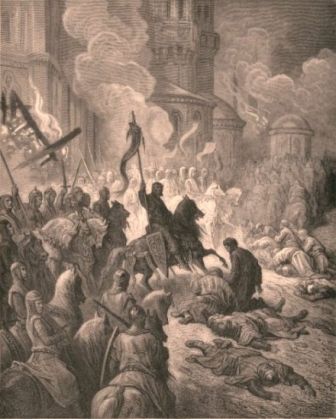
The Byzantine 4th Crusade
Vic Biorseth, https://www.catholicamericanthinker.com
The Byzantine 4th Crusade is widely recognized today as one of history's most unmitigated disasters, in terms of what was planned and intended versus what was accomplished. The tangled story of the Byzantine Fourth Crusade is so full of sub-plots, political and financial crises and pressures and hidden, ulterior motives that the original intent of the whole enterprise just got lost, and left in the dust, as the “Leaders” were ever increasingly passively reacting to events rather than proactively causing them. Or, in some cases, there was, quite possibly, hidden evil intent on the part of some of the leading characters right from the beginning.
Today, we cringe at the very thought of a Christian host besieging, sacking and burning a Christian city; but most of us are unfamiliar with the culture of the era, and even the then existing precedence of similar events. Raising a great host or army, in those days, was a relatively rare and quite expensive undertaking. Once the host was assembled, before using it for its original purpose, the nobleman who raised it would always immediately use it, first, to settle accounts with all subservient or vassal entities who might be in arrears in rents, taxes or tribute, in order to help pay, feed and sustain the host on its intended campaign. In addition, in accordance with custom or unwritten law, all castles, walled towns and city-states in the path of the host would generally send out emissaries to offer support, in the form of fodder for the animals, cattle or other animals for food, water, and even sometimes tribute, in order to keep the host from “foraging” too broadly to feed itself as it marched along. Sometimes they even sent guides to aid the host in getting through and beyond the territory as quickly and uneventfully as possible. The mere appearance of a large host would be sufficient to get open offers of support for the march.
As a precedent for the Byzantine 4th Crusade, most today are unaware of the historical fact that Constantinople, although it had never fallen to a foreign invader, it had often surrendered to a rival emperor, usually after only a brief or token assault, in the imperial ascensions of 610, 743, 963, 1057, 1078 and 1081. Had it not been for the military brilliance of Conrad of Montferrat, that would have been the case in 1187. Alexius I Comnenus succeeded in an armed coup in 1081 using a foreign army, and he even allowed the customary three-days of sacking the city, which was the then expected payment of the host from any city that offered military resistance to the host, and required fighting. So, Constantinople had already been sacked, by one of its own emperors. In the history of Constantinople, most usually, all a claimant to the throne had to do was show up at the gates with a large host, and the negotiations would begin. With this in mind, it is somewhat easier to imagine how, once this Crusade was diverted into becoming the Byzantine 4th Crusade, it might have expected to just show up at the gates and be welcomed, perhaps after the briefest of skirmishes and the weakest of resistances.
As another point of historical fact, before this particular effort even began, the very notion of “The Crusades” to free the Holy Land had been defeated on the Horns of Hattin, as shown in The Medieval Crusades page. Later events would show that that event was fatal to the larger cause, and the whole effort was already doomed to failure. Be all that as it may, this particular Crusade couldn’t have been scripted any better in Hollywood, or Disneyland; it’s a story so fantastic as to be hard to believe.
By the time of the Byzantine 4th Crusade the Latin Church and Western culture had a developed doctrine of the Crusade. The Germanic and other barbarian tribes threatening the Roman Empire contributed to Augustine’s development of his Just War theory. The disintegration of the Carolingian Empire and the onslaught of Viking, Magyar, Moslems and others lead Latin Europe, not long removed from its own barbaric roots, to assert the virtues of Holy War fought in defense of the Church and the defense of existing cultural and civic establishment. In more recent history the experience of the medieval Crusade had merged the idea of the pilgrimage into the doctrine.
Pilgrimage meant the undertaking of a journey by a penitent to sacred shrines for religious benefit. Originally, pilgrims went unarmed, and as late as 1065 in the Levant some even refused to defend their own lives with arms. Pope Gregory VII sanctified the armed pilgrimage, and transformed the meaning of militia Christi from the figurative to the literal interpretation. It had previously referred to monastic asceticism; under Gregory, it was expanded to include military combat. All of this stemmed from the religious and cultural importance given the religious pilgrimage.
When the first medieval Crusade set out from Europe the doctrine was not yet fully formed, but by the time of the Byzantine 4th Crusade it had developed, and the canonists had elaborated a specific doctrine for the Crusade, which could be summoned or authorized by the pope, with a specific goal, for a specific period and against a specific enemy.
The Taking of the Cross, for the order and action that was to become the Byzantine 4th Crusade, was first preached in 1198 by the new pope, Innocent III, who was acutely aware of his responsibility as the leader of Christendom, and of the failures of the Crusades thus far in the deliverance of Jerusalem. The call was aimed at towns, counts, dukes and barons, who should provide Crusaders for a period of two years at their own expense. Kings were specifically not mentioned, because Innocent intended the new Crusade to be more under papal control than it would be if any King was involved.
According to their resources, the towns and nobility were to supply men and/or money for the cause. Both pilgrims and contributors were offered indulgences for the remission of sins, and those who put on the Cross would receive protection of their goods and property, and a moratorium on the interest of any debt. Bishops were also asked to give of money and/or men. Collection chests were set up in Churches everywhere to collect the donations of the masses.
But the call largely fell on deaf ears, for Western culture was distracted by troubled times in the feudal societies of Christendom.
The civil distractions adversely affecting the timely launching of the Byzantine 4th Crusade involved war and political instability. England and France were in a continuous on-and-off state of war, since Richard Lion Heart returned from captivity in 1194. Count Baldwin of Flanders was at loggerheads with his own French suzerain, the French King Phillip Augustus. Two of the West’s greatest maritime powers, Genoa and Pisa, were at war with each other. Philip of Swabia, allied with France, and Otto of Brunswick, allied with England, represented two rival claimants to the imperial crown of Germany. The boy-King Frederick and his mother Constance were fighting to maintain Hohenstaufen rule in Sicily. Pope Innocent, continuing his predecessor’s work to stabilize Western culture and end feuds and wars, used the very real (in his eyes) need of the Byzantine 4th Crusade to unite contentious Western powers against a common enemy.
Innocent was bitterly disappointed when the date called for passed with no response to his call. He levied a papal tax on clergy to increase funding for the enterprise, and continued to preach the Crusade, in increasingly strong terms.
The first to heed the call were the commoners who were motivated by the preaching of a charismatic priest named Fulk, of Neuilly, at a country Church near Paris. His fame began because he preached in Church and in public strong sermons about the two major vices of usury and lechery. He pointed out, in public, the worst example sinners in these vices, including even other priests and their concubines. He was credited with “saving:” numbers of concubines and prostitutes from lives of sin, either recruiting them into orders of nuns, or finding for them dowries and husbands.
How Fulk came to be so motivated to preach the Byzantine 4th Crusade is not clear, but once he started, his popularity, fame, rhetoric and charisma moved many to put on the Cross. He traveled broadly, preaching everywhere. He became a zealot in the cause, and recruited monks to preach the Crusade for the pope. Although he did enlist a few nobles, Fulk was noted to have personally bestowed the Cross of the Crusade on literally thousands of commoners. Which was troublesome to some, because it harkened back to the horrors of the likes of Peter the Hermit and similar past “leaders,” who motivated and led unruly mobs of ill-prepared commoners to their own eventual slaughter. These were not trained and disciplined fighting men; in military parlance, they were rabble, easily confused, quick to panic and likely to break ranks under pressure.
But most of those moved by Fulk to take up the Cross seem to have been rather lightly motivated, for they did not follow through. In the heat of the moment, under the spell of fiery rhetoric, they enthusiastically responded. However, like the seeds cast in shallow soil, the commitment did not take good root, and soon withered in the light of worldliness and reality.
The first nobles, in serious numbers, to heed the call for the Byzantine 4th Crusade were all participating in a tournament, of all things. A full 15 months after Innocent had called for the Crusade, and six months after the date it was supposed to depart, Count Thibaut of Champagne held a tournament at his castle at Ecry-sur-Aisne in the Ardennes region of northern France. Popular legend, not backed up by any real history, places Fulk there preaching to the Nights. History does not record what happened there to recruit the Nights, but whatever it was, it was probably fairly dramatic.
Medieval tournaments were comprised of competitive matches using the martial arts of the era, exercising the precise skills that would be required of participants of the Byzantine 4th Crusade. Nobles and Nights from far and wide gathered to test military prowess, to display honor, to impress the ladies, and to enjoy the heraldry, pageantry, feasting and social amenities of their high class. While all gentlemen – meaning all noblemen and Nights – were highly skilled with weapons, having been born to it, and having been continuously trained in combat since very early childhood, it is unlikely that they were any more or any less pious or religious than the commoners in their domains. It seems unlikely that these men were moved solely by religious zeal to take up the Cross, although some may have been, and religious piety certainly affected them all. Christian piety ran much, much deeper through all levels of society then than it does today.
But one characteristic of this class made them less likely to drop the Cross, once having donned it. And that one thing was all bound up in the code of Chivalry, and the associated personal sense of honor. Once a Gentleman - noble or a Night - gave his word on something in the presence of others, especially the ladies, he was honor-bound to keep it. If they had second thoughts after taking up the Cross, as so many of the commoners had, they could not so easily put it aside and forget it. To do so would be to bring disgrace upon them. At this tournament of champions, we might not know what the original motivation was, but we know that, based on what they all swore, one after the other, that the Byzantine 4th Crusades was definitely On.
The initial wave of enlistments for the Byzantine 4th Crusade that came out of the tournament at Ecry or shortly thereafter included about a hundred “companies” of about a hundred men each. Most were commoners. The usual proportions for medieval armies were approximately one heavily armored and equipped nobleman or Night to two lighter armed and equipped mounted squires or sergeants, and about four to six foot soldiers, or sergeants on foot. All of these were highly skilled fighting men, committed to backing up their leader. This support included everything from carrying and maintaining his armor and weapons to actual combat in his support. The typical gentleman’s entourage often included one or more carts or wagons for weaponry, armor, tents, water and provisions. When gathered into a great host, the champions (gentlemen) would comprise the “heavy horse,” the mounted squires made up (or led) the light cavalry, and the sergeants on foot comprised (or led) the infantry.
Noblemen, of course, normally resided in large castles or fortified palaces. Lesser nobles resided in fortified manner-houses or smaller castles. Nights generally resided in towers or lesser fortifications within the domain of their suzerain. All were not equal; a poor Night might have only one squire, with no (or one or two) other assistants; a prosperous Night might have multiple squires and a large entourage of various assistants. All Nights were generally expected to hold and defend some part of the domain in vassalage to their suzerain, to be prepared to sally forth against any intruders, and to generally respond favorably to calls to action.
In the great effort that would become the Byzantine 4th Crusade the early leaders were the Counts Thibaut of Champagne, Louis of Blois and Baldwin of Flanders. While they set about the business of raising an army, they sent ambassadors, including Geoffrey of Villehardouin, the Marshal of Flanders, to find and negotiate transportation by sea. France had no port with the capability of building or obtaining the ships for such a major enterprise. Pisa and Genoa were somewhat depleted and exhausted from their war with each other, and the envoys representing the Byzantine 4th Crusade thus wound up in Venice.
These envoys carried with them the full authority to bind the nobles who sent them to contracts not yet written, and they were fully authorized to go anywhere, and to negotiate significant contracts with anyone. The trust thus placed in these men by the nobles was virtually unlimited. All the details were to be worked out by them, and whatever agreements they made would be binding on the nobles. They needed a fleet to carry the great army they were raising. So, the envoys of the Byzantine 4th Crusade eventually wound up in the great port city at the head of the Adriatic, the only major sea power city-state not otherwise occupied by troubles and war.
There they met the great Enrico Dandolo, the Dodge of Venice, who was perhaps the most fascinating character in the whole story of the Byzantine 4th Crusade. No fiction writer, no Hollywood producer, no bizarre artist of any kind could possibly have invented such an incredible personage. The envoys were welcomed with the pomp and honor that befitted ambassadors of great feudal Lords.
The great Dandolo entered at the end of a huge procession, preceded by his sword, a chair-of-state draped in cloth of gold, and a parasol; he was garbed in imperial splendor. Dandolo was quite old, at least an octogenarian, and – he was absolutely blind, since some time after 1176, when we know that he still had his vision. Advanced age had done nothing to dull his mental acuity, and indeed had apparently only sharpened it, as he was increasingly recognized as an excellent strategist, tactician, diplomat and negotiator, and the possessor of a particularly penetrating sense of politics. He alone in this entire story represented what we today think of as a King; he was in practicality, although not in title, the Monarch of the City-State Republic of Venice.
Dandolo received their credentials and the letters committing the noble Principles to whatever contracts these men negotiated. He agreed to grant them an audience four days hence, an indication of how important he thought they were. Dandolo was universally respected for his benevolence and his eloquence, but he was very busy with the responsibilities of Venice. Some who wrote of the Byzantine 4th Crusade describe him as delaying the negotiations, but this seems not to be true. He was personally involved in multiple ongoing litigations and affairs of state that demanded his attention and time.
The Byzantine 4th Crusade Contract was negotiated at the audience with Dandolo. That men in those days showed more emotion, and were more emotional, than men today might be a gross understatement of the case. Apparently, when men put forth a proposal that they fervently believed in, it was generally done with the accompaniment of outbursts of open weeping. That great men of war, perhaps the greatest in the world, would put on such emotional displays was quite surprising to me, although real scholars of the era might not be surprised at all. This audience involved men falling down in tearful, emotional displays, involving refusal to get up from the spot until their request was granted.
It's hard to say how that sort of thing might play today, but then, at that time and place, it triggered similar emotional and tearful outbursts from the listeners, and quite emotional commitment to the cause.
The great cause, the Crusade for Jesus Christ and the holy places of Jerusalem, was very emotionally set forth by Geoffrey, the Marshal of Champagne, ending with a request to obtain a fleet of vessels for the mission. They requested vessels sufficient to transport 4,500 Nights, 4,500 horses, 9,000 squires and 20,000 foot soldiers. This was the original request of the envoys for the nobles of the Byzantine 4th Crusade.
As we shall see, this would turn out to be a gross over-estimation of the forces that would be raised and that would actually show up to be transported. It did not appear to be any fault of the envoys; the great feudal Lords who sent them fully intended and expected to raise a force of this size, or larger, from the outset.
Eight days later they met again and Dandolo offered to build and provide the fleet at a cost, in the currency of Cologne, of four marks per Night, four marks per horse and two marks per squire and foot soldier, for a total of ninety-four thousand marks. In addition to the requested transport, Dandolo offered to supply at the expense of Venice fifty war galleys to support the Byzantine 4th Crusade on the condition that Venice would receive a half-share in any spoils of war taken. This did not mean land; it meant plunder. Venice would also provision the Crusade for one year by sea at no further cost.
The next day, agreement was reached; all terms were as above, but the total payment was reduced to eighty five thousand marks of Cologne to be paid in four installments by April 1202, when the army of the Byzantine 4th Crusade should arrive in Venice. The fleet would be ready to sail on June 29, the feast of Saints Peter and Paul.
At that point, an important leader of the rank and power similar to that of a King began, inexorably, to get more deeply involved in an enterprise that the pope who called for it specifically intended to exclude from the control of any King. Dandolo was, in effect, the “King” of the most powerful maritime city-state in Western civilization that was not involved in a war at the time. And, as events later would prove, his personal attention and commitment would be drawn deeper and deeper into at least overseeing if not participating in the actual leadership of the Crusade as a simple matter of protecting his and Venice’s truly massive investment in it. In the best case, this Crusade would be a great windfall for Dandolo, Venice, the whole surrounding area, legions of carpenters and craftsmen, sailors and others. On the other hand, if this venture failed, or if did not otherwise pay off, it could potentially bankrupt Venice and bring about a financial/economic crisis of epic proportions. Enrico Dandolo and Venice each had a vital personal interest in the success of the Byzantine 4th Crusade.
Not counting the 50 war galleys, this bargain meant building 450 new transport ships for the fighters and mounts of the Crusade, and a concentrated effort to meet the demands of the bargain that entailed suspending all other Venetian commerce for some 18 months, just to concentrate on satisfying the needs of this one contract. Although ship-building in that era was largely a private enterprise affair, the Dodge of Venice had authority and influence enough to engage all of the private ship yards throughout the entire lagoon to concentrate on this single effort. He also began the effort of gathering the many tons of provisions needed for the venture from the entire surrounding countryside. Most difficult of all may have been the supplying of the manpower for the war galleys and the sailing crews of all of the transport ships. This likely entailed the recruitment of some 14,000 men, around half of the able-bodied seamen and fighters of Venice. It was without a doubt the largest economic undertaking in all of Venetian history.
Meanwhile, behind the scenes, a seemingly unrelated intrigue was developing. In Byzantium, the emperor Isaac was dethroned, blinded and imprisoned by his own brother, Alexius, in a palace coup that placed Alexius III on the throne in Constantinople. In Byzantium, blindness was seen to be a disqualification for rule. Isaac’s youthful son, also named Alexius, who, with his father, promised to not plot against the throne, was not blinded and was allowed relative freedom of the palace and court, although he was carefully watched by the new emperor Alexius. In a daring escape, he cut his long hair, donned Western apparel and mingled with the foreigners on a ship bound out of Byzantium. He was not recognized by searchers as the deposed Prince, son of Isaac, and was able to make his escape. The young Alexius managed to contact his sister Irene of Germany and obtain armed escort and safe passage to the court at Hagenau.
These events were unfolding as Geoffrey of Villehardouin, the Marshal of Champagne was returning to the great Lords with news of the contract executed with the Doge of Venice regarding transport of the great Crusade to the Levant. They found the Count Thibaut of Champaign quite ill and bed-ridden. He knew he was dieing, and he settled his affairs and made out a will. Although he roused himself from bed when he heard the good news, he soon returned to his bed, and in short order, he died. Since he had been more or less assumed to be the over-all leader of this Crusade, in so much as there could be such a leader among co-equal, independent-minded feudal lords, this called for a great council to determine who would take his place. The determination of the remaining lords fell to Boniface, Marquis of Montferrat, and Geoffrey was sent to offer him the post, the men and treasure Count Thibaut had willed to the leader of the Crusade.
We must here recognize that any title or rank accepted by any feudal lord or even King that sounded like overall command was not the same as it would be today. There was at that time no such thing as the unity of command that today’s military men would recognize. A lord could not even be certain that his own vassals, and their men, let alone any other lord, would all unhesitatingly follow his every command in every circumstance. A Crusading host comprised of many separate noblemen and their retinues would be more akin to several large cattle drives all headed in the same general direction, as compared to a modern day large army/navy/air force with a single mission. Generally, exact orders regarding destination, timing, battle plans and so forth would be so general as to be almost non-existent, at the level of the common fighting man. The reasons were that, many men, if they knew where they were going or what they were doing ahead of time, would simply change course and not follow the course laid out for them. The lords themselves would be given vague and unspecific instructions by the “leader,” and the farther down the line the orders trickled, the vaguer they would become. In those days, mass-desertion could be a greater drain on manpower than battle itself.
Boniface Marquis of Montferrat was held in high esteem by virtually everyone. He even acted as emissary between the feuding factions of the house of Hohenstaufen and the house of Welf for the German Empire, and was trusted by both sides. He was indeed a vassal of Phillip of Swabia, a Hohenstaufen, yet he acted as go-between on behalf of the Pope for Otto, whom the papacy favored, while seeking truce if not peace between the two factions. When he received the Crusade leadership invitation from Geoffrey, he first went, as a matter of protocol and honor, to Phillip Augustus, King of France. He then met with the other Crusade nobles at Soissons, in an orchard adjoining the Benedictine abbey of Notre Dame.
At Soissons the crusading barons, on their knees, offered the Lombard Boniface, Marquis of Montferrat, command of the host, and all the treasure left by Thibaut for the Crusade, and all the fighting men who had been vassals of Thibaut. As had happened at the negotiations in Venice, there were great emotional demonstrations and outbursts by great men. Boniface himself very emotionally fell to his knees before the other nobles and Nights, and irrevocably committed himself to the cause of the Crusade. They all moved into the abbey church of Notre Dame to solemnize the proceedings. Nivelon, the bishop of Soissons, along with the two Cisterian abbots and the now famous preacher Fulk of Neuilly, fastened the cross on the shoulder of the Marquis of Montferrat. The day after he took the cross, Boniface left to settle his affairs.
His return to Montferrat was not direct, however. He first spent some time at the great abbey of Citeaux in the Burgundian wilderness, for the “general chapter” meeting of the white monks on September 13, the eve of the Exaltation of the Cross. The white monks had been very involved in preceding Crusades, and many other nobles and Nights were in attendance. Boniface recruited some of them to his cause, and in particular, obtained permission for the company of Abbot Peter of Locedio, for his good counsel. Boniface then paid a visit to his own lord (and cousin) Phillip of Swabia, at the court of the German King at Hagenau. They were on good terms with each other, and Boniface sought support, in whatever form he could get it, for his new cause. Boniface had visited Phillip as an envoy of the pope in an attempt to settle the dispute over the German throne, and, he had represented the Hohenstaufen cause in Paris to Phillip Augustus, King of France. Because of the ongoing dispute between Hohenstaufen and Welf, it was unlikely that Boniface could recruit many, or even any, of the barons of Germany, since things were so unsettled at home. Yet, he was duty bound to try.
It was at Hagenau that Boniface encountered the unexpected guest, the young refugee Byzantine prince Alexius, son of the recently deposed and blinded emperor Isaac II Angelus. They were distantly related. Alexius’ sister, Irene, was the wife of Phillip of Swabia, King of Germany and Boniface’s suzerain. Boniface’s brother Conrad had saved Alexius’s father’s reign with his military skill. Conrad had later been cheated of his reward, and another brother, Renier, had been poisoned in another Byzantine political intrigue and plot in Constantinople. The young Alexius began trying to persuade Boniface of Montferrat, brother of Conrad and Renier, to come to the aid of his father Isaac, and to help him depose the current emperor Alexius III, and to help the young prince Alexius himself to ascend the throne in Constantinople. But the single minded intent of Boniface was fastened on the oath he had taken. The Crusade would have to come first. But the young Alexius, perhaps seeing in Boniface his last, best hope, however uncertain, of regaining his inheritance and the throne, began to fasten himself to Boniface.
Prince Alexius had visited the pope and returned before Boniface arrived at Hagenau. There he petitioned the Holy See to help “return” him to power in Constantinople, but the pope was not inclined to do so. In so far as the papacy was concerned, Alexius III had as much entitlement to the throne as his brother Isaac II, but the claim of the young prince Alexius to the throne was weaker, and considerably less convincing. The prince had been born before the ascension of his father Isaac to the throne, not after, and he was not viewed to be any sort of automatic heir to it. The prince returned to Hagenau without the support of the papacy. Later, after meeting the young prince at Hagenau, Boniface of Montferrat also visited the pope, and, one of the several things they discussed was the request of prince Alexius to Boniface for aid in “rescuing” the throne at Constantinople from his uncle. By this time, Innocent was somewhat vexed by the very idea, now put before him a second time, and he strongly rejected it, and Boniface obediently agreed to pursue the original goal of freeing the Levant from the Moslems, and not detouring toward or campaigning against any Christian city.
The papal prohibition did contain an escape clause, in that the Crusade could not be diverted from its sworn mission, and could not militarily engage any Christian city without due cause, or, unless necessary. It might become necessary if some Christian entity openly opposed the Crusade, or somehow hindered or prevented the progress of the host toward its sworn goal.
Boniface then went to Lerici, a small town between the warring cities of Genoa and Pisa, attempting to mediate a peace between them, acting as a mediator for pope Innocent. The Marquis then returned to Montferrat to make his own personal preparations for departure on the venture that was to become the Byzantine 4th Crusade.
A point to remember in all of this is that the proposal of the young prince Alexius, now rejected by Phillip of Swabia, despite the passionate support of it by his wife Irene, Alexius’ sister, and now rejected by the Marquis of Montferrat, and rejected by pope Innocent, is that is was less a plea for armed siege and assault as it was for an armed “show of force” for an assumed palace coup, with an assumed rally of support for Alexius and his father Isaac from within the walls of Constantinople. It had happened before, and it was the sort of plea that would not necessarily be rejected out-of-hand by most gentlemen of that day. It might not take utmost priority, but neither would it be summarily dismissed. It was, however, fraught with danger, in that it could quickly escalate into a great battle against the strongest Christian bastion on earth, at that time. Constantinople had never fallen to any foreign invader, for many, many centuries, and many invading armies had been broken on her walls. That had happened before, too.
It was soon becoming apparent that the numbers of those who had taken on the Cross were falling far short of the contracted-for numbers. It was recognized even at the initial gathering places in various originating domains, was further confirmed as the Crusaders marched and joined those of other domains, and at virtually every encampment or gathering point. Each lord was dismayed at the turnout of his own vassals, and then was further dismayed as he encountered other lords and compared notes. Many traveled through Montferrat and paid their respects to the Marquis, and the numbers were, always, down.
Now, while the details of where the Crusade was first bound – Egypt - were not widely known, the nature of the contract and rough estimates of the overall cost of it were widely known, by the nobles, Nights and the host. No one was yet concerned about the cost figures. But, those who had taken the Cross, particularly those of lower rank, fully expected the Crusade to be heading directly to the Holy Land, perhaps even to Jerusalem herself. The high level decision to go to Egypt involved the timing of an existing and not expired truce between the King Aimery II and the Moslems, and the strategic idea of taking Alexandria first and closing the “back door” of Moslem reinforcement of the Levant from Africa. The Crusade could then enter the Holy Land from a position of strength. If the rank and file of the host had known of the first sailing destination and the first battle plan targeting Egypt, many of them might have simply either deserted the cause, or set out on their own separated from the main body bound for Venice. In fact, rumors of the plan for Egypt may well have contributed to the numbers who left for the Levant on their own, rather than with the host gathering in Venice. Scattered rumors of the planned Egyptian campaign slowly began to percolate through the host.
The great Crusade cost factor was of great interest to me, because it highlights the faithful naiveté of the nobles of the era. The effort that would become the Byzantine 4th Crusade, like all other Crusades, would be paid for by the participants – those who had taken upon themselves the Cross. They all knew that. However, the leading nobles alone had legally bound themselves to the terms of the contract for transport with Venice, and they alone would be held accountable for those terms. Disregarding the purely legal aspects of the contract, they were so heavily honor bound to honor it as to be very nearly enslaved to it. Each member of the host who arrived in Venice with his lord would, of course, pay his agreed share to his lord, if he hadn’t already done so ahead of time. But there were many lesser nobles and “poor” Knights who paid little, and most of the commoners in the host paid very little or nothing at all, other than their own very risky physical contribution to the Crusade.
As it became increasingly apparent to all Nobles that the numbers were severely down, many hesitated, and even began to seek alternate routes to the Levant. Some sought to avoid the potential ugliness of being part of a weakened and virtually impoverished host making its way as best it could to the Holy Land. Or, worse, unable at all to keep their vows of the Cross, and forced by circumstance to return home in disgrace.
Collection chests from monasteries and churches for the cause were frequently divided up, sometimes by high ranking clerics and sometimes by the pope himself, between the lords leading the specific Crusade, and the various lords and orders currently under duress in the Levant itself; these funds were mostly viewed as intended for the overall great cause, thought of as “The Crusade,” rather than the current individual Crusade being organized. Thus, most of these funds went directly to the Holy Land, and were of little benefit to the satisfaction of the Venetian contract.
Every prominent Crusader had a certain amount of autonomy, his own goals and plans, and felt bound to the larger host only insofar as the larger host served his purposes. This was also true, although to a lesser extent, even of the common people who took the Cross. This presents a situation that would be intolerable, even unthinkable, to modern military commanders. Be that as it may, many nobles and their vassals, and many Nights and their entourages, for various reasons, sought their own transport to the Levant, other than by way of Venice. Several hundred Nights, who should have been part of this Crusade, found their way to Palestine in their own way, usually sailing from other smaller ports. Going by the usual proportion of men to Nights, this may reasonably be estimated to have included more than two thousand fighting men. While this was not enough to make a real difference in the critical situation developing in Venice, it didn’t help it either.
Renaud of Dampierre, the Night who had been entrusted with the duty of fulfilling the Crusading vow of the dieing Count Thibaut of Champaign, was one of these. Heading straight for Antioch, he was ambushed by the Moslems, and his entire band of some eighty Nights was wiped out. Only one Night escaped; Renaud himself was captured and would remain in Moslem captivity for some thirty years. Some failed to show at Venice due to other factors. John of Nesle, leading perhaps as much of half of the force of Count Baldwin’s force from Flanders, set out by ship, only to encounter difficult sailing. All summer long they struggled against contrary winds before passing through the Straights of Gibraltar. They burned and sacked an unnamed Moslem port on the Mediterranean, and decided to take to port in Versailles for the winter.
Those who arrived at Venice, always in disappointing numbers, traveled by the customary route via the Mont Cenis Pass and Lombardy, with stops at various shrines and places of piety, such as Clairvaux and Citeaux. They came from the sub alpine provinces of current day Italy, and from Flanders, Picardy, Ile-de-France, Blois, Shartres, Champagne, Burgundy and the Rhineland. There were few or no English; while King John collected a tax on lands for support of the effort, he was deeply engaged in a struggle for his throne with his nephew Arthur, who enjoyed the support of Phillip Augustus. John still managed to send one thousand marks for the effort through his nephew, Louis of Blois. King John not only did not accept the Cross himself, but placed obstacles in the path of other English enlistments. Clerics did not push the issue, for Innocent did not want any Kings involved.
Most who arrived at Venice came out of the initial wave of enthusiasm that was born of the tournament at Ecry. A more limited contingent came out of Germany, lead by Conrad of Krosigk, Bishop of Halberstadt, excommunicated by Innocent for his support of Phillip of Swabia over his rival Otto. He was seeking penitence, penance and perhaps absolution via the Crusader’s Cross. Accompanying him was Count Berthold of Katzenellenbogen, Henry of Ulmen and several other lesser German Lords.
Remember, the Treaty of Venice had not been made in the name of the whole host, but soley in the names of the Counts of Flanders, Blois and Champaign, and now the Marquis of Montferrat, who had willing accepted and taken upon himself the commitments of the deceased Thibaut of Champaign. The army, as a whole, had no corporate character and no standing as an entity in law. The cost of transportation was, as always, the burden of each individual Crusader; they all paid their own way, and helped each other out as best they could. This meant, sometimes, foraging, as well as looting of any enemies encountered.
During this period, before the host was fully gathered in Venice, the popular preacher of the Crusade, Fulk of Neully passed away, causing much grief and a general lowering of moral, for it was seen to be a bad omen on the eve of the great Crusade. Fulk had gathered possibly the largest amount of treasure for the cause, but very little of it would be available for the payment due to Venice. Much of it was already spent, and more willed, by Fulk for the support and transportation expenses of many poor Crusaders; thousands of them. Much more had already been sent to the Holy Land, where it was largely used to do needed repairs to fortifications and living facilities after a devastating earthquake. Huge amounts were spent in this fashion in the repair of the walls of Acre, Tyre and Beirut.
Venice, for her part, had fulfilled her obligations to the Treaty fully and completely. All the ships were built, rigged, crewed and ready to sail. All provisions had been gathered and loaded aboard. Fifty war galleys stood ready, provisioned and manned, to support the effort. Venice had literally stopped all other commercial activity throughout the entire area just to enable the completion of all the work, provisioning, recruitment and training needed to satisfy the contracted requirements. Most importantly, there had been no income for anyone in the area for fully a year and a half, in anticipation of payment from the great Crusading host for all this effort. This put just about all ordinary citizens and businessmen of Venice in near desperate financial straights.
Despite the theories of some historians, at least up to this point in the story, the evidence shows that there was no diabolical plot to divert the Crusade to Constantinople, by the Venetian Dodge Enrico Dandolo, or by Boniface, Marquis of Montferrat, or anyone else, the continuous hopes and prayers of the young prince Alexius notwithstanding.
As elements of the Crusade slowly straggled into Venice, they were directed to the Island of Saint Nicholas (the Lido) in the lagoon, where their pre-embarkation encampment was established. All the Venetian ships for the Crusade, about 500 of them, rested at anchor off of the Lido. The Venetians and their Dodge grew increasingly alarmed as the stream of fighters never seemed to hit the expected crest, and then slowly began to peter out, with such clear and obvious low numbers as to ensure that the entire expected 33,000-plus figure would not be met. Ultimately, the numbers amounted to around a third of the expected, and contracted for, numbers. Panic began to set in.
The great Crusading lords had each brought with them sufficient funds from their own domains only, fully expecting other lords, in sufficient numbers, to join them in the cause. They had all acted in good faith. They had settled their personal affairs, including putting heirs or temporary rulers in charge of their domains, made collections and even sold some lands to raise funds for the Venetian Treaty before departing for the encampment on the Lido. As the departure date approached and then passed with the numbers still far below expectations, with all those contracted-for ships standing there at anchor, the specter of dishonor began to rise before them all.
On the Venetian side, the aged, blind, but wise and charismatic Dodge Enrico Dandolo was no king, although he enjoyed almost king-like respect and veneration from the Venetians. He had a ducal council and a Great Council to answer to, as well as the people of the Republic, from whom he had demanded so much, and to whom he now owed payment for services rendered. He was the one they all turned their faces toward, in full expectation of being paid their just dues in fulfillment of their many individual contracts.
In the midst of this growing quandary, cardinal Peter Capuano, the papal legate, arrived on the scene, and nearly everything he did had a negative effect on the situation. For whatever reason, he arrived late, after the date of departure for the 4th Crusade, which had passed with the host still encamped on the Lido hoping for more arrivals. He was a total stranger to the French lords and to the Venetians alike. The first thing he did was to go onto the Lido and begin sending Crusaders home; he removed the cross and the vow from the poor, the sick and the women. When the lords and the Venetians became aware of what he was doing, they were infuriated. The lords didn’t want their manpower reduced without their input, and the Venetians didn’t want the contracted-for numbers reduced even further, for payment reasons.
Once the credentials of Peter Capuano were recognized, the anger was suppressed to some degree. It appears that the French lords eventually accepted him as the papal legate, but distrusted him, and did not consult him on matters pertaining to route, destination or strategy. The Venetians did not even accept him as papal legate. They informed him that he could accompany the Crusade as a preacher, but that he would not be accepted as papal legate. His influence was thereafter considerably less than it should have been. The 2nd and 3rd Crusades had been lead and financed by kings; this one was supposed to be more under the control of the pope, and his legate was supposed to be his man on the scene and his direct representative. As Peter Capuano’s influence and importance was lessened, so was the direct influence of the pope lessened.
The cause, mission, assemblage and organization that would morph into what history would record as the Byzantine 4th Crusade was, from that point on, not controlled by anyone.
Venice, the greatest city in Latin Christendom, now faced a financial disaster. The Dodge of Venice went to talk to the barons on the Lido about the terms of the Treaty. After the meeting, Villehardoun and others recorded that the Venetians had fulfilled the contract completely. The ships all stood ready, crewed, manned and provisioned, well ahead of the date of departure. It had taken a great deal of time and treasure to build and/or purchase all of those ships for the cause. The French lords then asked the host, the great and the small, to pay more into the collective pot to satisfy the terms of the Treaty. Some of the poor Crusaders who remained despite the efforts of Peter Capuano declared that they could pay no more; the lords collected what they could from those who could pay more.
The great lords then held a council and decided to impoverish themselves rather than default on their word. It was not unanimous; only the lords who’s names were on the Treaty felt absolutely bound by it. All had already given their fair share, and most gave more, at this point. The counts of Flanders, Blois, Saint Pol, and the marquis of Montferrat, and others of their persuasion, gave everything they had, in money, and in gold and silver vessels, ornaments and other items. The host witnessed the carrying of all the vessels and treasure of the lords from the Lido across to Venice.
It was not enough. They still lacked 34,000 marks of the 85,000 originally contracted for. There were no other funds available. The situation began to get ugly, in many ways.
The Venetians were pressing Dandolo for payment, and Dandolo pressed the lords for payment. He even threatened to cut off their water supply on the Lido, although he never carried through with that threat. Today the Lido is a beautiful beach resort, but then, it was a little strip of sun-baked barren sand, blistering hot in the Italian summertime. Nothing is worse for the morale of an army than prolonged inactivity. Wild rumors were rampant, and desertion was now becoming a growing problem. Impoverished soldiers were getting food on credit, and getting new Venetian loans just to continue to eat. Venetian merchants were growing more alarmed at how much food they were sending to Lido for no real money in return.
Venetians were also growing increasingly alarmed at the presence of a large foreign army within their defenses. The Lido was an island, but transport between the island and Venice was close and easy. Some Crusaders were traveling farther and farther to find more willing merchants with whom to deal for food and establish credit. Some of these Crusader foragers never returned. Time was also becoming a crucial factor. Medieval men did not sail the seas in winter season, even in the relatively mild Mediterranean. The idle, hungry host had seen the vessels and treasures of the lords transported to Venice, and they assumed the Venetians had been paid, perhaps too much. They grumbled against the Venetians as much as the Venetians grumbled against the host.
The great lords informed the dodge of Venice that they were unable to pay any more, and Enrico Dandolo realized the truth of their words, as well as the gravity of the situation for all involved. He discussed the matter with his advisors, including the potential menace to Venice of this increasingly demoralized host festering within the defenses of Venice. No such foreign force had ever been allowed into the lagoon before this.
In discussing what to do with this foreign army, the topic of Venice’s ongoing conflict with Zara was raised. Zara was a port city of Dalmatia; it is the current city of Zadar in Croatia on the Adriatic Sea. It had been, on and off, a vassal state of Venice, changing hands repeatedly between Vassalage to Venice and to the king of Hungary. It had always been important to Venice as an Adriatic port for replenishment of the Venetian fleet, and as an important source of hard oak, for ship building. Zara stood alone in the entire region in open defiance of Venice.
As mentioned earlier, it was universally accepted in medieval Europe that a ruler had the right to stabilize his domains, quash rebels and exact oaths of loyalty before leading his newly raised army on a Crusade. This was commonly done both in the preparatory phase as the army was raised, and on the march, through or past vassal estates. Venice still considered Zara to be a vassal state, although Zara now enjoyed the protection of Bela III of Hungary, who had built a strong fortress there.
Dandolo dangled a proposition before the French lords. It consisted of using the Crusading host to help return Zara to Venetian rule in return for a temporary moratorium on the 35,000 mark debt, until it could be paid out of the Crusader’s portion of any loot to be taken in future battles. The alternative, of course, was to cancel the entire Crusade and return home in disgrace.
The lords had to confer with each other, and with the papal legate, and Dandolo had to confer with the ducal council and the Great Council; but it looked like a way to continue with the Crusade. Peter Capuano, the papal legate, accepted the proposition as a lesser evil for the sake of a greater good. He said that, while Innocent could not condone any attack on Christians, he might overlook it if the alternative was the disintegration of the entire Crusade. The papal prohibition forbade attack on Christians except in case of necessity and after consultation with the legate. There was a general agreement among the lords to sail to Zara.
Peter Capuano’s decision enervated anew the hopes of young Alexius Angelus toward somehow regaining his throne in Constantinople, perhaps through the offices of the legate. And particularly since he, once installed on the throne, could personally finance the whole of the Crusade.
There was the problem of the fact that this was almost entirely a French undertaking, with merely contracted support from Venice. The Venetians had not, necessarily, taken the cross, although some individuals may have. The port of Zara was (or had been before the last revolt) a vassal of Venice, not of any of the French lords. This problem dovetailed with another problem, that being, the ever growing Venetian interest in the success of the entire enterprise, which involved the very economic survival of Venice itself. Here, the political insight and acumen of Dandolo showed itself at its best.
The blind, old dodge took the cross. At the Mass of the Nativity of the Virgin in San Marco, filled with Crusaders and Venetians, the dodge appeared in full ceremonial garb, ascended the pulpit and addressed the congregation:
”Sirs, you are joined with the most valiant men in the world in the greatest enterprise that anyone has ever undertaken. I am old and weak and in need of rest, and my health is failing. But I see that no one knows how to govern and direct you as I do, who am your lord. If you agree that I should take the sign of the cross to protect and lead you, and that my son should remain and guard the country, I will go to live or die with you and the pilgrims.”
San Marco rang out with the cries of Venetians assenting to his request and clamoring to take up the cross themselves. The dodge descended to kneel before the altar in tears, to the cheers and tears of Crusader and Venetian alike. The Crusaders rejoiced at the crossing of the dodge, and of the new recruits joining them. Enrico Dandolo enjoyed as much personal popularity among the Crusaders as he did among the Venetians.
The news was spread that the debt was forestalled, the Crusade was on, and departure was imminent. A great celebration began on the Lido. Spirits were lifted in the whole area. The initial target of Zara was kept from the rank and file, because if they knew ahead of time that they might be re-directed against a Christian city, they might have deserted the host and either returned home as best they could, or found their way to the Levant as best they could. The position of the pope, it would turn out, was opposed to the proposition. Once he learned about it, he sent a strong letter forbidding it. Although it arrived in time, the majority of the lords chose to ignore it; the Crusade, by that time, had developed a momentum of its own.
The Imperial Refugee Alexius Angelus had been hovering nearby, in Verona, keeping close tabs on the plight of the floundering host. When it became clear that the great Crusade would sail, he sent envoys to plead his case anew to the French lords. These envoys met with a small group of the French lords and assured them of the strong support of many Byzantine magnates and lords, including all the more powerful elements of Byzantium, who longed for deliverance and hoped for the return of the young prince as emperor. Boniface, alone, had previous knowledge of this plan, which had already been twice rejected by the pope, and by Phillip of Swabia, and by himself. He held his tongue and said nothing of it to the others.
The messengers assured the nobles that if they would but sail the short distance to Constantinople and act to place Alexius Angelus on the throne, that they would be paid sufficiently to satisfy their all of their existing debt, and to finance the entire enterprise on into the Levant. It would be an easy exercise, because the prince enjoyed so much popular support from within the walls of Constantinople. The proposition was received in a positive light, although all of the lords were not present, and when some were later informed of it, they opposed it. It was decided to send envoys to Phillip of Swabia and to the pope to present the idea. Boniface said nothing.
On the eve of sailing to Zara, the envoys left for Hagenau and for Rome. Boniface accompanied those bound for Rome, with his close advisor, Abbot Peter of Locedo, who had enjoyed pope Innocent’s close confidence for many years. Bonniface hoped to avoid the action at Zara, and planned to rejoin the Crusade afterward, wherever it might sail again. He had no taste for attacking a Christian city. He must have had some foreboding about the reaction of Innocent to the issue of Constantinople, now being raised before him a third time. Yet, he now may have hoped that the support of the other French lords and the severe financial crisis might soften the negative position of the pope. He might have hoped to just stand in the background while others pleaded the case.
The arrival of Boniface’s party before Innocent was preceded by that of cardinal Peter Capuano, the papal legate to the great Crusade. He informed Innocent of the plan to attack Zara, the crossing of the dodge of Venice, the refusal to accept Capuano as the papal legate, and the proposition to install Prince Alexius Angelus on the throne in Constantinople. Innocent immediately sent the letter forbidding the attack on Zara. Capuano was to remain in Rome, but not in disgrace; he remained the papal legate, but Innocent would not be ordered by anyone to appoint another legate. The Crusade would need to communicate with Capuano from a distance, because Capuano and Innocent alike would not suffer the indignity of the papal legate not being recognized on the scene.
The topic of Constantinople, now being raised a third time, infuriated Innocent. Innocent sent his letter, opposing Capuano’s position regarding Zara and threatening religious sanctions against any Crusader who attacked Christians, in the hands of Abbot Peter of Locedo. It would not arrive before the host stood before the gates of Zara. The notion of the Crusade being diverted to Constantinople was immediately dispensed with; Innocent remained adamantly opposed to it.
The fleet embarked from Venice with great pomp and circumstance, with trumpeting and drum rolls, and great spectacle. Dandolo sat in sartorial splendor in his great ship, which was painted imperial purple, sitting beneath a purple canopy on the high castle. Ship’s sides and castles were lined with the shields of the nobles and Nights aboard, all shining and fresh painted and making a splendid show. About two hundred forty of the available five hundred ships were actually sailing. Boniface was absent, on the thin excuse that he had other business to attend.
It is important to note that the fleet was designed and built to assault Alexandria, not Constantinople. The great transports, including the special horse transports, were designed to take advantage of the many sandy beaches in the environs of northern Egypt, where men and horses and machines of war could be placed ashore directly from the ships, and with relative ease. Constantinople had no such beaches available, and had higher towers guarding approaches than any of the towers on the ships. The ships had mangonels and siege weapons and towers aboard which were intended for Alexandria, not Constantinople. The fifty war galleys were built to battle Egypt’s great maritime force; Constantinople had no powerful navy.
The horse transports, in particular, were uniquely designed. They were large but very shallow-draft vessels intended to get very close to beaches to enable blindfolded horses to be led directly out of their stalls and onto the shore. Alexandria had such beaches available; Constantinople did not. The transports had special ramp-equipped water-tight doors built just above the water line to enable loading and unloading of blindfolded horses directly to and from individual stalls below decks. This eliminated the problem of lifting the horses by deck crane and then somehow getting them below decks, and it eliminated the reverse process to unload them. Each stall was equipped with a large belly-strap and winch, which allowed taking much of the horse’s weight off of his feet, preventing him from falling or moving due to ship motion, and keeping cargo weight properly dispersed around the ship. While this was hard on the horses due to immobility and chafing, it was seen to be much better than the older existing alternatives of the day.
The fleet stopped at a number of ports along the coast of Istria and Dalmatia, re-insuring loyalty and support, collecting past-due Venetian tribute and increasing the compliment of rowers and marines from among the populace, who owed Venice military support. Chief among these ports were Pirano, Trieste and Muggia. The fleet arrived before Zara in early November. It was known and recorded before the fleet sailed that it was too late in the season to sail across the Mediterranean to Egypt, since the lateness of the arrival and preparation of the host beyond the contract date was realized. It was known ahead of time that the fleet would winter somewhere this side of the great sea, and so Zara became the intended place to winter.
Politics, Factions, Intrigues and Rationalization regarding the decision to attack Zara and Constantinople.
Now, the predominantly French host, supposedly under the command of the Italian Boniface, who was not present and, conveniently, “tending to other important matters,” was ordered by letter from pope Innocent to not attack any Christian city, and it was clear that if they disobeyed this order they would incur upon themselves excommunication. No formal sentence would need to issue from the See of Rome; the disobedient act itself would bring about the excommunication. From the view of pope Innocent, Boniface was the man in charge; in actual fact, since the crossing of the dodge, it could be argued that this Crusade was now, primarily, a Venetian thing, and that Dandolo was the real man in charge. And Zara was a former Venetian vassal that was in a state of revolt against its suzerain.
So there was really nothing revolutionary about stopping at Zara; it was seen to be within the rights of Venice. To forestall the payment of their severe debt, however, the host had to agree to besiege Zara if she resisted, and that was the real problem.
The biggest single argument in favor of following Dandolo to Zara was the notion that all that might be necessary would be to show up and appear before the city with this great fleet and this great host, and a peaceful settlement would likely be negotiated, without any fighting at all. Of course, the destination of Zara and the intentions toward Zara were kept from the rank and file until the last moment, but all the lords and Nights knew full well what was going on. It looked to be the only way to forestall overdue payment due the Venetians and keep the Crusade itself alive. Still, fighting was not beyond the realm of possibility.
On the one hand, if they incurred excommunication upon themselves, they would not only lose the indulgences and privileges gained when they took the cross, but they would also lose access to the saving grace from any and all the sacraments of the Church, seen at worst as final damnation, and at best as severe hindrance to salvation. Some of the German lords and bishops who’s suzerain was Phillip of Swabia were already under excommunication, and had taken the cross as an act of contrition and penance, hoping to get back into grace with the Church.
On the other hand, if they did not go to Zara, the Crusade itself, as an identifiable entity, was ended. Most of them couldn’t even afford to make their own way to the Levant. They would return home as best they could in disgrace and poverty.
If, for the host, Zara held the promise of forestalled debt, Constantinople held out the promise of debt elimination, and even of enrichment; more on that later.
When Zara saw the approach of the great fleet, she raised her great chain across the entrance to the harbor. One of the fleet’s massive transports ran upon the great chain and broke it, whereupon most of the fleet swarmed into the port. Nights and squires were landed unopposed. The doors of the transports opened, ramps lowered, and the great war horses were led blindfolded to shore. Siege weapons were unloaded and prepared for action. Since they were unopposed, they encamped where they were. Even though they represented only about a third of the contracted-for host, they were still an imposing host, by Western standards or any standards at all, particularly when backed up by all those highly visible ships of war.
The military facts of the matter on the ground at Zara were these. Zara was cut off from all support from anywhere. The Venetians were close to home, on what was essentially a Venetian lake (the Adriatic sea), and were easily resupplied and supported. While Zara had formidable fortifications, the Venetians and the host had time on their side; they had nowhere to go until spring, and more than enough time needed to reduce the city to rubble. These facts were not lost on the Zarans; they knew full well what jeopardy they were in. While they could put up a fearsome resistance for a time, they could not hope to win in the end. Without the ability of their Pisan or Hungarian allies to relieve them, they had no choice but to offer terms.
On November 12, two days after the fleet arrived, a Zaran deputation came to the crimson pavilion of the dodge, Enrico Dandolo, to offer terms of surrender. What they offered was the city and all its goods to be dispensed with at his discretion, with the sole condition that the lives of the inhabitants be spared. The surrender was total.
It was perhaps too rich a moment for Dandolo, and he savored it too long. He had worked and waited long for this moment, and had expended much energy toward it, and now Zara stood at his mercy. He replied that he would need to confer with his French allies before accepting their terms. Which was nonsense, of course; there is no way that the lords would refuse those terms, and Zara was his vassal, not theirs, and the matter should have been settled right then. Dandolo must have wanted the Zaran deputation to spend some time wringing their hands and worrying about survival before he finally gave them their answer. But he waited too long.
The procession of the Zaran deputation to the pavilion of the dodge did not go unnoticed by the Crusading host, and it was clear to all that a surrender was now in progress. For most, this was the best news possible, but there was another faction among them that didn’t appreciate the very idea of being in Zara at all. For them, this news made them angry. Chief among them was Simon de Montfort, one of the first French barons to take the cross back at the tournament at Ecry. He and others among the French had not been happy about the direction of the Crusade since its leadership had been “co-opted” by Italians – first Boniface and now Dandolo – and were certainly not happy to be part of a Christian military force, under the cross, arrayed against the walls of a Christian city. For them, the surrender of Zara was unjust and tragic.
Simon de Montfort and followers visited the Zaran delegation while they awaited Dandolo’s answer, and poisoned the well, as it were. He assured the Zarans of the pope’s support, and that of many of the Crusading host as well. He assured them that none of the host would join the fight if they decided to resist, and their fight would be against the Venetians alone. The host was there for show alone. Reinforcing this message was Robert of Boves, brother of Enguerrand, who rode to the walls of the city to announce to the defenders the same story Simon of Montfort was announcing to the surrender deputation. The deputation thanked Simon for his support and returned to the walls of Zara. So much for an immediate surrender.
Note well that nothing in the pope’s letter forbade the Crusaders from wintering in Zara or from accepting a surrender if freely given. The matter could have been settled peacefully.
Dandolo met with the French lords, and apparently no one noticed that Simon do Montfort and others were not present. Of course, the barons voted and fully agreed to accept the surrender. They then accompanied the dodge to his pavilion to conclude the agreement, where they found no Zarans, but Simon and some of his followers. The dodge and the barons were astonished and angered at what had transpired. Before much of an explanation was offered, a very serious feudal challenge was laid before everyone.
Guy of Vaux-de-Cernay, with the pope’s letter or a copy of it in hand, stepped forward and exclaimed “I forbid you, on behalf of the Pope of Rome, to attack this city, for those within are Christians and you are Crusaders!” and further that to ignore this order would mean excommunication. Violence erupted immediately. Venetians tried to kill Guy on the spot, but his life was saved by Simon de Montfort.
When things calmed down a bit, Enrico Dandolo addressed the Crusading leaders, not the dissidents, saying “Lords, I had this city at my mercy, and your people have deprived me of it; you have promised to assist me to conquer it, and I [now] summon you to do so.”
Which put the lords on the horns of a dilemma. When they could have had a peaceful settlement, now they were re-presented with excommunication on the one hand, and violation of a sworn commitment on the other, along with the death of the rest of the Crusade itself. Everyone was furious at this action instigated by Simon of Montfort.
Many of them never would have agreed to sail to Zara in the first place if the papal legate had not approved it. Now they had the letter before them, and the chance of a surrender was scuttled. More than anything else, it was anger at Simon de Montfort that tipped the scales for the decision to besiege Zara.
What amounted to a truly small and insignificant contingent of dissidents, consisting solely of Simon de Montfort and Enguerrand of Boves and their contingents, moved their encampment to a separate area away from the rest of the host, to not be party to the battle. The Zarans, having taken the word of Simon, refused to believe their own eyes as the host formed up and prepared the weapons of war. The Zarans hung crucifixes from the walls to make it further sacrilegious for Christians to assault them, and watched as the host trenched around the landward sides of the walls and the fleet ships maneuvered close to the seaward side.
It didn’t take too long to come to the shocking conclusion that the Crusading host, unhappy as it was, was determined to reduce Zara and to do it just as quickly as possible. Mangonels, petraries and other engines of war were employed as sappers tunneled undermining the walls to cause them to collapse. The Zarans were unable to thwart the sappers, and their defenses thus far caused few casualties among the host. They soon saw that the situation was hopeless and again offered surrender, again on the sole condition that their lives should be spared. This time it was immediately accepted.
On November 24, the feast of St. Chrysogonus, Zara was occupied, a poverty stricken soldiery was unleashed and the city was put to the sack. Everything of value was plundered, much else was destroyed, and even churches were profaned and looted. The dodge did not honor the terms of the surrender, for many of the city’s leading characters were beheaded, and many more exiled. For the winter, the Venetians occupied the port area of the city, and the Franks occupied the more inland areas.
Much later, perhaps in 1205, the dodge wrote to pope Innocent attempting to justify the conquest of Zara; there is no indication of how that communication was received. He stated that he knew about the papal prohibition, but that he didn’t believe it was a real one at the time. Whatever his relationship with Rome, and whatever the state of his immortal soul, he felt justified in his action for Venice.
Zara was a former Venetian dependency that had revolted; Zaran pirates preyed upon Venetian shipping within the Adriatic; Zarans had even allied with Pisa to challenge their dominion in that area. Venice had made a monumental investment in the Crusade itself, and stood to face a financial catastrophe if the Crusade itself failed or did not pay what was due on the contract. I think you can see that the conquest of Zara was not a simple cut-and-dried story, but was very complex.
Many among the host were concerned about the state of their souls, particularly when subjected to the condemnations of the followers of Simon de Montfort. As a counter to that condemnation, most of the Crusading bishops “absolved” the army of their sin and lifted the ban of excommunication. This was completely uncanonical and ineffective, of course, but it served as a stop-gap effort to sooth the consciences of the soldiery. The leaders did send a delegation of two bishops and two Nights to the pope to explain their situation and seek proper forgiveness. There was no Venetian representative among them, for at that time the Venetians did not admit to the sinfulness of the act.
Early on in the occupation of Zara there erupted violence between the French and the Venetians. Animosities and jealousies ran high on both sides. It got so serious that the lords and Nights actually had to don full armor before venturing into the fray to separate the combatants. As soon as they stopped the fighting in one area of the city, it would break out anew somewhere else. Before it was all quieted down, over a hundred were dead, mostly Venetians. The dodge and the leaders then had to spend considerable time and effort calming the troops and quieting the animosities between the soldiers and the sailors.
Boniface arrived in mid December to find animosity and division between the Venetians and the French, division among the troops, the dissident camp still apart from everyone else, and the quieter but more serious problems among the leaders. The Venetians still needed their payment; it was not eliminated by the action at Zara, merely postponed. The French felt that the Venetians were getting the best of everything and, some suspected, had already been paid more than enough. The dissident faction felt that most of the host had betrayed the Crusader’s vows, and most of the host felt betrayed by the dissidents.
The German envoys from Phillip of Swabia arrived in Zara on the first of January bearing news of the young Byzantine prince Alexius. The arrival was not unexpected by Villehardouin and the other leading barons since they had sent their own envoys to Phillip in support of the imperial hopeful. For the vast majority of the Crusaders, and for the Venetians, the whole story of prince Alexius and his plight came as a complete surprise. The envoys and the barons met with the dodge in an audience in the house the dodge was occupying.
Phillip of Swabia had changed his mind on the matter.
The envoys presented their credentials as legates of Phillip of Swabia and also of prince Alexius. They affirmed Phillips’ desire to send his brother-in-law, prince Alexius, to join the host, and stressed the responsibility of sworn Crusaders to uplift the downtrodden. “Because you march for right, and for justice, you must return the inheritance to those who have been despoiled of it, if you are able.” This was the action that was called for; the envoys then turned to the reward for this service.
- Prince Alexius would place the Greek church in obedience to Rome.
- He would supply the Crusading army and provide them in addition with two hundred thousand marks.
- He himself would raise an army of ten thousand to join in the Crusade for one year.
- Throughout his life he promised to maintain five hundred Nights in the Holy Land.
The German envoys possessed full powers to conclude a treaty on those terms. Of course, as hindsight proves, the young prince Alexius had no comprehension of either the realities on the ground in Constantinople, or of the enormity of the commitment he was making to the great lords. Or, perhaps, he felt desperate enough to promise anything. Desperate men are disposed to promise anything. From the other side, the situation of the great lords was desperate also, and desperate men are likely to grasp at any offered solution that sounds good.
Prince Alexius had grossly over estimated his influence over the Byzantine church. The envoys assured the great lords that the greater part of the population of Constantinople desired the overthrow of the usurper who occupied the throne, and the restoration of Prince Alexius to his rightful rule. This, of course, would prove to be yet another gross over estimation.
The factions weighed the new factors pertaining to the decision to sail to Constantinople rather than Egypt, even as most of the common soldiery still thought they were all bound straight for Jerusalem. The German faction was leery because some of them were already under excommunication because of prior alignment with Phillip of Swabia against Otto, and hoped for exoneration by having taken up the cross and marching for Innocent. However, their position was complicated by the fact that now, their suzerain, Phillip of Swabia, now ordered them to act to place Alexius on the throne at Constantinople.
The Franks were divided, mostly for Constantinople, but some against, led by Simon de Montfort, who saw himself as the champion of papal policy. Some Nights from Champaign who were jealous of the Italian leadership of the Italians from Montferrat and Venice, and of the money Boniface had received from Count Thibaut’s legacy opposed the German proposal and sided with Simon de Montfort. Boniface came down on the side of his suzerain, as did most of the Franks. After some discussion and argument, Dandolo and the Venetians favored supporting Alexius.
Among the clerics, the divisions were similar. Abbot Peter of Locedio followed his lord Boniface, but was terribly troubled because of his attachment to Innocent, and the trust Innocent had placed in him. Abbot Simon Loose was perhaps most prominent in the party favoring Alexius. Abbot Guy of Vaux-de-Cernay, follower of the count of Montfort, was chief spokesman for the clerical foes of the Alexius undertaking. Having already adamantly opposed the attack on Zara, he became even more adamantly representative of the known position of the pope.
The bishops of the host were evenly divided on the issue. The only bishop who strongly opposed the German proposition was Peter, bishop-elect of Bethlehem. The Abbot of Vaux-de-Cernay and his party went farther than most in opposition, insisting that the Crusade proceed at once directly to Jerusalem, and not even entertain the strategy of Egypt first. They forcefully called to mind the Crusader’s vows that they had all taken long ago and which remained unfulfilled.
The one thing that none of them intended – and this is very important – is that not a single noble, Night, cleric or Venetian intended to conquer Constantinople outright. No one in his right mind would have intended such a thing. So far as they knew at the time, that would be a near impossible task, and they were of insufficient force to do it. Constantinople was huge, the fortifications immense and very nearly impregnable, and had stood for centuries against all challengers, and there had been many who had tried and failed. While it may seem terribly naïve today, to our ears, at that time there was no reason to doubt that young Alexius did not have the Byzantine support he claimed to have, or that he could not deliver on any of his promises.
Bottom line: it was a way for the Crusade to continue.
Phillip’s Treaty was eventually signed by the greatest of the barons: Boniface of Montferrat, Baldwin of Flanders, Louis of Blois, Hugh of Saint Pol, and a few others, at another meeting with the German envoys at Dandolo’s temporary lodgings in Zara. They felt they Crusade would be terminated and they would be disgraced if they rejected it. They did this despite the lack of consensus and the open opposition to it among and between the various factions.
Boniface later said that he acted decisively in a desperate situation because the army was out of provisions, and he claimed – falsely – that he was following the advice of the papal legate, Peter Capuano. The signing of the treaty did not put an end to the controversy or the arguments. The Venetians had hoped that the value of the continuance of the Crusade itself would be a significant enough factor to put the matter to rest, but the factions continued to bicker about it.
The full story was beginning to emerge from secrecy and come into the awareness of the commoners and the host, and the discussions at that level were just as heated as any. Many pilgrims and lower class soldiers had been subsidized by loans – not grants – from the Church. These vowed and crossed Crusaders had obliged themselves to not return home without evidence of having fulfilled their Crusading vows, in the Holy Land, against the Moslems. The “evidence” was required to be letters attesting that they have fulfilled their vows, signed by one of the following: the king of Jerusalem; the patriarch of Jerusalem; the papal legate; the master of the order of the Templars; the master of the order of the Hospitallers. Without one of these letters, they would be required to pay back the loan, which was sizeable. They were increasingly coming to distrust the great lords, who they viewed as more moved by worldly gain than religious zeal. Yet, many of these were moved by the same motivations, at a lower level.
And hard, cold practicality entered the arena in the lower class arguments as well; the odds were not good that they would ever get to the Holy Land to fulfill their vows if the whole enterprise disintegrated right there in Zara. Traveling alone, or in very small groups, whether cross-country through Byzantium or by ship across the Mediterranean, had already proved so very dangerous as to be foolhardy. With the great lords, they had a much better chance than apart from them. And, as much animosity as they all entertained against the Venetians, all those Venetian war galleys were very reassuring.
The Crusader envoys sent to the pope, meanwhile, had begged for absolution from the excommunications brought about by the battle for Zara. They said the sin had been “committed with grief” and compelled by necessity. If they had not committed the sin against the Christians of Zara, they said, the entire Crusade would have ended and the army would have fallen apart, because of the failure of the contract, and an impoverished host left without transport. They were truly contrite and willing to do penance, and awaited his instructions, which they swore to follow.
Innocent was furious, but he was also practical, and he searched for a solution. He could not destroy, via excommunication, the Crusade he had called into being, when the sinners were contrite and promising to sin no more. Canonically, as a priest, he could ask no more of a penitent in the confessional. But there was no Venetian among the delegation, and he wondered why the Venetians were not asking for absolution too. When they told him that the Venetians did not see themselves as sinning in this act, he determined to absolve the host, but not the Venetians, who would remain under the ban of excommunication.
This posed a new difficulty, because Christians are forbidden to have any dealings with excommunicates, except that Christian family members are permitted to remain with excommunicate family members. Here we had a Christian host to be transported and defended, at sea, and provisioned, by an excommunicated fleet. But, of course, popes frequently prove to be as resourceful as they are powerful.
Innocent sent two letters back to Zara with the Crusader envoys; one for general public consumption, and the other for only the eyes of the great lords and the clerical leaders of the Crusade.
The first letter, for public consumption, was a very blunt condemnation of the sin committed against Zara, and the harm done to the Crusade, the vows, and the cause of the Holy Land. While accepting the difficulties that led to the sin, he stated that these difficulties were self inflicted. He would grant conditional absolution if proper repentance were shown. The conditions:
- The leaders were to ask for pardon from the king of Hungary, and return to him the spoils of war taken from Zara.
- The clergy were instructed to inform the rank and file that the Holy See forbade them to attack any Christians, unless forced to do so by a just cause, and even then only with prior papal approval.
- The lords were instructed to send to Rome sealed statements in which they swore to henceforth obey all papal orders.
When these conditions were satisfied, the papal legate or his nuncio were authorized to absolve all penitents by apostolic authority. Of course, the first condition, involving returning the spoils of war taken from Zara, could not possibly be fulfilled without getting the Venetians to give back the spoils, which the Venetians were not inclined to do. As it would turn out, this first condition was never met.
The second papal letter, for the lords and leading Crusader clerics alone, held out the hope that the Venetians would see the error of their ways, repent of their sin, and seek papal absolution. But if they remained in their sin, the Crusaders were granted permission to work along side the excommunicate Venetians for the good of the cause, because the fleet was so essential to the greater mission. If the Venetians remained in their sin, the pope granted permission to the lords and the clerics to “dissemble” – to disguise or conceal behind false appearances – in their communications with the Venetians, telling them whatever it might take to get them to transport the army. Once the Venetians have delivered the army, he said they might “seize the opportunity to repress their evil,” which appears to be thinly veiled papal justification for putting the Venetians to the sword.
In the same letter the pope addressed the Constantinople issue. Aware of the financial problems of the great lords and the possibility of the whole enterprise failing on this issue, he sought to ease the situation somewhat, without involving any installation of the young prince Alexius. He had already spoken on that issue, once to Alexius, twice to Boniface, once to the envoys of the lords of the Crusade, and once to the sitting Alexius III, who had communicated to him about the known plans of the young prince and the great lords. He was tired of it. Innocent stated that he would write to Alexius III instructing him to make provisions for the Crusade. If he refused, Innocent left the door open for the Crusaders to take needed provisions by force, arguing that necessity excuses many things when an important cause is at stake.
The papal letters were suppressed; the lords and clerics said nothing about it to the rank and file. The problems seemed insurmountable.
While the absolution was greeted with enthusiasm, everything else seemed to be bad news. They had already committed themselves, by treaty, to install prince Alexius, and it was too late the change their minds. There was already too much dissent in the ranks, and if the new papal prohibition got out, the whole cause would be ruined. Receiving, or taking, “provisions” from the Greeks was of no real benefit, because they already had food, so long as the Venetian contract held up and did not expire. What they needed was money. Prince Alexius offered money; the pope did not. They needed to renew the contract with the Venetian fleet for at least another year. Nor did they like the notion of sailing directly to Egypt to “suppress the evil” and kill the Venetians, which might eliminate their sizeable debt, but end their ongoing Venetian support by sea, and leave them stranded, and virtually impoverished, in a hostile land.
In the end, a combination of honor, practicality and greed won the day. Prince Alexius offered enormous wealth in return for what appeared to be a quite simple task. Very importantly, the code of Chivalry here directly collided with obedience to the pope. Lords and Knights did not give their word lightly, and signed contracts simply had to be fulfilled. It might be argued that they should have held off until receiving papal input; but once they put their hand to the contract, they could not so easily turn from it. Their whole lives were wrapped up in the Chivalric sense of honor. If it were not for the importance of this code, they all would have abandoned the cause back on the Lido and simply went back home, and these further complications would not have occurred at all.
So Chivalry trumped piety again. The Treaty was already signed, and therefore the decision was final.
The host moved out of the city and pitched camp on the shore to await the arrival of Alexius. The Venetians then virtually destroyed the city, burning and pulling down palaces and castles, reducing all buildings except Churches to rubble, ostensibly to eliminate the threat of future Zaran piracy. Venice would later send a contingent to build a strong fortification on a nearby island as a continuous presence to resist and suppress pirates in the area.
The Original Venetian Treaty clock was still ticking away; one half of the one year contract was already used up. Inactivity and waiting is not good for any army. Morale is always at its best when there is movement toward an identifiable goal. Impatient for the arrival of the young pretender, Prince Alexius, most of the host and the fleet sailed for the island of Corfu, with Boniface and Dandolo left behind awaiting the arrival of Alexius.
When he finally arrived, Alexius was greeted with as much pomp and circumstance that the few remaining Crusaders and Venetians could muster, and they set sail for Corfu. Upon their arrival, there was a significant greeting by the great lords, and – the cat was out of the bag, so to speak. Prince Alexius was now present, his mission and purpose was made public, the true direction of the great Crusade was made known, and much of the lower level lords and Nights, and the rank and file, were quite stunned by it all.
It must be remembered that only a few of the great lords had actually put their hand to the Byzantine Treaty; they remained divided on the issue, even at that high level. Those who opposed going to Constantinople were very strongly opposed. The division ran right down the middle of every class and faction involved in the entire enterprise. Among the many bishops, abbots and priests, among the greater and lower lords and Knights, among the squires and sergeants, among the simple pilgrims, and among the rank and file footmen, the division seemed the same. Half, or perhaps even a majority, were opposed to the whole notion.
Among the clerics, those who favored it might have seen for themselves future Byzantine Sees and parishes, since Alexius promised to return Byzantium to unity with Rome. Among the lords, extreme wealth was dangled in front of men who had already spent everything they had on this enterprise. Knights and sergeants were torn between their Crusader vows, and allegiance and fealty to their suzerains. At the lowest level, the most important factor involved the clock, which was still ticking. They only had half a year left on the Venetian contract; going to Constantinople could eat up that time and leave them unable to get to the Levant at all, let alone be supported there by the Venetian fleet. How were they to fulfill their Crusader vows?
By this time several lords with significant followings, including Simon of Montfort, had already left the host and set out for the Levant, and there had been many lower ranking “desertions” of contingents who disagreed with the direction of the Crusade, since even before Zara. Most of them made separate Treatise with the king of Hungary and made their way by land; a very difficult journey which itself took quite a toll. None of those who made it to the Levant accomplished anything of significance there.
John of Nesle and the Flemish fleet with half of Balwin’s force that had wintered in Versailles, now represented a force even greater than the remaining host on Corfu. They had planned to join up with the main host at Modon before sailing to Alexandria. Modon was the dividing point – the place from which one would either sail to Constantinople, or to Egypt, or to Syria. But the Flemish fleet was not completely out of contact, and they had word of what happened at Zara, and what was about to happen at Constantinople, and they encountered the exact same arguments and divisions among themselves as the main body under Boniface and Dandolo.
Within that force, the dissidents won the argument; John of Nesle and the fleet from Flanders sailed directly to Syria. Like all the others who went straight to the Levant, their efforts were largely wasted, because of the still running peace Treaty between the king of Jerusalem and Islam. They all wound up involved in various feudal contests, political intrigues, internecine wars between Christian factions, they suffered from disease, and just dwindled away to nothing.
On Corfu, Young Alexius, seeing the clear division among the lower classes, decided to try the then popular tactic of the emotional appeal. He first knelt in the middle of the camp and gave a tearful and heart rending speech calling for help to “restore” his throne, and then fell down weeping, vowing to not get up from the spot until all agreed with his mission. It didn’t work. His display was greeted with angry howls, taunts, and a near riot. He was seen as a spoiled child and his “mission” as a mere lark. Some tried to shout the dissenters down, but the dissenters out-shouted the supporters, and appeared to be in the majority. When things began to get violent, Alexius had to leave the scene in humiliation.
The camp was so rigidly divided on the issue that it physically divided – the dissidents actually moved their tents some distance away from the main encampment, and it soon became apparent that the dissident camp was considerably larger than the remaining supporter camp. The dissidents were now actively seeking other routes or transport to the Levant. They sent word to Walter of Brienne in Apulia pledging to serve him and asking him to send ships so they could join him. The rift appeared permanent.
So, the suppression of the papal letters had only prevented the overwhelming majority from quitting the leaders immediately; it did nothing to convince them of the wisdom of any new detour to Constantinople. Alexius’ appeal to their emotions and their piety came across as little more than an immature tantrum. We can only imagine what the reaction might have been had everyone been informed of their excommunication since Zara, and of the papal prohibition to install Prince Alexius.
The lords held another great council to determine what to do; it appeared that the entire Crusade was now doomed. The determination came to be another emotional appeal, but, to be done by all of the great lords, and all of the bishops, and all of the abbots, and all of the Nights who belonged to the Constantinople faction. It was better to go down in humiliation than to just let the enterprise fail and let that be the end of it. They had already invested so much that they had to try whatever they could.
So, they rode to the dissident camp, and dismounted. The dissidents, who were also mounted – perhaps fearing being attacked – also dismounted. The great lords, and the bishops, and the abbots, and many popular Knights, then fell to their knees and protested with lots of tears that they could not rise until the dissidents would promise to not withdraw from the army. Now, the logic here was no different than it was with the previous appeal by Alexius; however, it was not every day that men saw these great lords on their knees and in such distress. The dissidents declared that they needed to talk it over, and they withdrew some distance to discuss the matter while the lords and other leaders remained on their knees.
The dissidents returned with a proposition for the Marquis. They would rejoin the Crusade on the condition that they would spend no more than one month in the environs of Constantinople, unless they gave prior consent to any extension. Their main concern was the time left on the Venetian support contract. They demanded that the Marquis and other leaders swear on the Gospels that, if the Treaty of Venice expired (St Michael’s day, September 29) and they were still not in the Levant, that the lords would provide ships for transportation to the Levant within 15 days of the request.
The Marqis and the leaders agreed, but stipulated that the length of time must be kept secret. If the sitting Byzantine emperor and his party knew ahead of time about a time limit, they might put up a stronger resistance to the host, knowing that the host would leave the field on a date certain. This had been the most serious threat to the enterprise so far, and the Crusade was still on. The host would now go to Constantinople, gain Alexius’ throne for him, be paid in money, troops and supplies, the Byzantine Church would be restored to unity with Rome, and they would proceed to the Holy Land. (As far as the common troops knew, they were not going to Egypt first.)
As part of this agreement, young prince Alexius was required to swear upon sacred relics that he would keep all of his promises.
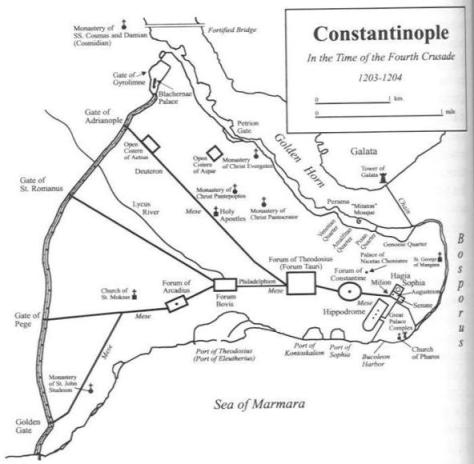
From The Fourth Crusade, Queller and Madden, pg 100
The Fleet Set Sail for Byzantium, once again united in purpose, for the time being. The innocent naiveté of the participants and protagonists, present and distant, is clear in the historical record. Pope Innocent III truly believed that all that the 4th Crusade needed was provisions and a little money in order to proceed to the Levant. Alexius III, fully aware of the advancing Venetian fleet and the great host, appears to have believed the same thing. Although he knew that young prince Alexius was with them, he couldn’t believe the host would actually fight and die, against Constantinople, just to put him on the throne.
The dodge and the great lords really believed that prince Alexius actually did have the popular support that he claimed within the walls of the great city, and that he actually could – and the primate, clerics and populace would agree to it - bring the Greek Orthodox Church back into the fold of Rome. Young Alexius himself appears to have actually believed all of this. They all further actually believed that, once installed, Alexius could actually produce the huge amount of money and the number of Knights and all the other support he had actually committed himself to produce.
The fleet replenished itself by foraging on the Greek islands of Euboea and Andros, where the populace surrendered to prince Alexius after some bloodshed, and crops ripe in the field were taken by foragers from the host. The water barrels were refilled and the fleet sailed on. Emperor Alexius, meanwhile, did little or nothing to prepare for the battle; perhaps he didn’t believe it would come to that. He was a decent enough personage, given to pomp and show, but cowardly and weak as a leader. He would rather bluff his way out of a war by rich, dazzling pomp, heraldry and court displays before the envoys and messengers of potential enemies. Defenses at Constantinople had been neglected for years. There were plenty of admirals receiving huge stipends in his court, but there were no ships and there was no navy. What’s worse is that everybody knew it. Most of the defenses depended entirely too much upon paid foreign mercenaries and previously defeated foreign forces who owed service, who’s commitment was somewhat suspect, and even they were in low numbers, considering the size of the place. Still, the numbers of the various mercenary bands and the native warriors combined amounted to some three to four times that of the Latin host.
There was a significant number of Pisans present in the city. Pisa was a continuous economic foe and an occasional military foe of Venice, and the Pisans would stand with Constantinople. The problem with the defending forces was less with numbers than it was with determination and commitment, and, most importantly, cohesiveness, and willingness to sacrifice greatly for the cause. Indeed, the only truly serious fighting force Alexius III could count on were the Varangian Guard, of Scandinavian and Anglo-Saxon decent, fearsome fellows who famously carried large battle axes on their shoulders, and who were also famously expert with the broadsword. These were the most elite of all Byzantine mercenaries, all sworn to defend the emperor, and having been in constant service to the emperor’s person for many proud generations.
About the only thing that had been done at Constantinople before the Latin fleet and host arrived in the vicinity was to burn and destroy structures and sources of food, water and cover that were outside the walls. Alexius III possibly felt, and with good reason, that the city’s massive walls and the population might be sufficient to keep out the host. At one point he reportedly ordered his non-existent navy to prepare for battle, which might be an indication of his limited grasp of the true situation.
On June 23, the eve of St. John the Baptist, the Latin fleet set anchor off the Abbey of St. Stephen, in full view of their destination some seven miles away. The sight was quite intimidating. Probably the ten largest Latin cities might have fit within the walls of Constantinople, and the walls and towers were taller than anything the Latins had ever seen.
The next day the fleet sailed straight up the Bosporus and right under the walls of the city. Both sides were over-awed. It was a huge fleet in full sail, but with rowers plied as in battle. The pennants and banners of all the great lords were flying, and the freshly painted and gleaming shields of all the Knights were displayed on all the ships, making for a spectacular show. On the other side, the walls and towers were quickly occupied by armed men and citizens beholding the fleet. Furthermore, many rooftops, hills and high places, including the Acropolis, which were high enough to see over the walls, were occupied by the citizenry who turned out en mass for the show.
The Venetian ships made port at Chalcedon, which was across the Sea of Marmara and across the mouth of the Bosporus from Constantinople, within clear view of the city, less than a mile away. Horses were led from the transport to graze and regain their legs, while foragers took the harvest of winter wheat that had already been gathered in and set standing in stacks. The lords and great men took up residence in several large palaces and houses while others pitched pavilions.
After a few days with no envoys from Constantinople making their appearance yet, the Latins decided to move north a short distance to Scutari, where they occupied one of the emperor’s palaces. The host moved overland while the Venetians sailed the short distance. There they nervously awaited the predicted palace coup, or envoys from the emperor seeking to negotiate a settlement.
A party of some eighty Nights sent on a reconnaissance mission to prevent any surprise attack came upon some Greek pavilions pitched a few miles east of Scutari. It was the encampment of Lord Stryphnos leading a force of 500 Greek cavalry. In the face of superior numbers, the Latins quickly formed up to attack, and when they saw them, the Greeks also hurriedly formed up for battle in front of their pavilions, almost all afoot, for there was no time to catch the horses, don armor and mount up. The Latin Nights quickly rode right into them, and the shock of the heavy horse charge devastated the ranks of the Greeks, who broke and ran with their leaders for miles. The usual course in such a situation would be to run them all down and take whatever weapons, armor and valuables they could get from their corpses. But in this case the Latins did not pursue them hard, perhaps still hoping for a more peaceful settlement. They looted the encampment and took many horses, highly prized because the ranks of the host had many men who were highly qualified cavalry fighters but were afoot because they had no horses. Only the chargers of the lords and Knights had been brought on the Venetian transport ships.
Some of the taken horses were chargers, and there were many smaller horses and mules also taken as prizes. Chargers were especially prized, because they were large and strong, bred and trained for the charge and for war, and for carrying heavy armor and heavily armored Knights. These were the ancestors of the great draft horses of later centuries. They actually enjoyed charging into and over other horses, men and various obstructions. Often when formed up and readied for the charge, the anticipated action got many of these great war horses into such an excited state that they were quite difficult to control and hold back from charging too early.
The shocking reality of the situation began to take hold, on both sides, on the following day. A Lombard, Nicolo Rosso, acting as envoy of emperor Alexius III, visited the dodge and the lords at the emperor’s summer palace in Scutari. His message was a question, and an offer, and a threat. He inquired why the Crusaders had entered a Christian domain with mischief on their minds, and offered them money and provisions to carry on to the Levant if they were poor. If they did not accept the offer and did not move on, the emperor intended to attack them.
The response was equally blunt. The Crusaders had not entered Alexius III’s domain, but that of his brother’s son, prince Alexius, and Alexius III had wrongfully taken possession of the domain in defiance of God and all that was right and just. If Alexius III would step down and place himself at the mercy of his nephew, they would beg the prince to grant him enough treasure to live a life of luxury and peace. Otherwise, Rosso was advised to not dare approach the lords again. Rosso left immediately.
Fear, foreboding and anxiety now began to weigh heavily on both sides of the Bosporus.
Alexius III had anticipated that the offer would be accepted, because he had been assured by the pope that the host had been specifically forbidden by him from seeking to dethrone Alexius III and install prince Alexius in his place. Now he had this exceedingly belligerent and menacing response from the Crusaders.
The Crusaders had anticipated either word of a palace coup, or contact for support from those seeking a palace coup, or envoys from the emperor seeking a negotiated settlement of some sort with the great lords. Now they had this exceedingly belligerent and menacing communication from the sitting emperor, and not a single word from any of the prince’s supporters.
Neither side had anticipated this state of affairs.
The lords imagined that the people of the city did not yet know about the real situation and that their lord, young prince Alexius, was actually present with them and ready to displace the tyrant. Perhaps the information was purposely being kept from them. It also seemed to them that Rosso, the envoy of the emperor, hadn’t known their true purpose for being there until they told him. It was decided to show the prince to the people and let them know that their deliverance was at hand. They would sail beneath the walls of the city with the young prince on display on deck, announce his presence to all, and signal the beginning of the insurrection or palace coup, or at least trigger someone to seek contact and alliance with the Crusaders.
The next day they set out with ten war galleys, with the largest and most ornate designated for the young prince, Dandolo and Boniface. Many Knights boarded the other galleys, and they rowed under a flag of truce, directly beneath the walls of the city, very close to the citizenry. As the young prince stood between the dodge and Boniface, they shouted out the introduction of prince Alexius, and their intention to install him on the throne. They entreated the people to rise up and join them, and that the city would suffer no harm. But that if they resisted, the city would be ruined.
It was quite a miscalculation on the part of the Crusaders. Boniface was well known and even revered; but the prince was not embraced as a valid claimant to the throne, and the dodge, a Venetian, was exceedingly unpopular, particularly with the many Pisans and some Genoese who manned the walls. And it was, after all, a Venetian fleet. The hurling of insults and catcalls was soon followed by the hurling of various missiles, despite the flag of truce. The prince was taken by the Greeks to be part of a Venetian political conspiracy to place their own man on the throne of their city in place of the current emperor, who favored trade with Pisa. This view greatly lowered the estimation of everyone involved, including even Boniface, in the eyes of the Greeks.
As the Venetians and the Crusaders returned across the Bosporus, they now knew beyond a doubt that there would be no support for their cause from within the walls of Constantinople, and there would be no palace coup. Prince Alexius had no Greek support; there would now need to be a major battle. Time was too short for a long siege. They must have been filled with dread; still, they were honor bound to keep their word, and to not let the Crusade flounder and fail.
A council of war was held to determine the best plan of attack. First, the geography, existing Greek fortifications and known Greek forces were considered, along with the Latin force strengths and weaknesses.
The enormous walls of the city, along the shores of the Sea of Marmara and the Bosporus, rose almost immediately at the water’s edge, and were exceedingly tall with projecting towers. They left almost no room or footing for anyone landed there, and any landing would be subjected to murderous rain of projectiles and harmful substances from the towers and the walls.
The port area, the protected waters of the Golden Horn, were overlooked by the city walls on the south shore, a military presence of some sort on the north shore, and two major strongholds at either end. At the mouth of the Golden Horn was the tower of Galata, from which a huge iron chain, with links as large as a man’s arm, blocked the mouth of the harbor across to the city walls on the other shore. At the other end, there was a fortified bridge. Any enemy who attacked the port area from landward would be subject to attack from champions who stood prepared to sally forth from the tower of Galata at one end, and from the fortified bridge at the other.
All possible approaches had be tried by many invaders over history. Past invaders who had had the most success, though none had ever succeeded, had put ashore somewhere and laboriously marched around to attack the city from the landward side. The port area was by this point in history considered to be extremely safe from attack. The reason it was called the Golden Horn was that it was the center of commerce for Constantinople, and had even sometimes operated as a safe port for commercial vessels while invaders were attacking the walls elsewhere. The Golden Horn, plus the sheer size of the city, made Constantinople very nearly impervious to any long siege.
The Latin force strength centered on the numbers of lords and Knights who comprised the heavy horse, and the Venetian fleet. The Venetians were clearly in total command of the waters, and were prepared to assail the walls directly from their ships. The Latins were not sailors, however, and preferred to do their fighting on land. While the fully armored Knight was quite a formidable warrior on foot, he was absolutely devastating when mounted. The question was how to get them to where they could do the most good.
The decision was made to take the Golden Horn by quick assault. It would require getting the armored, mounted lords and Knights on shore in the environs of Galata just as quickly as possible, before a sufficient opposing force might arrive at the landing. If successful, it would immediately disrupt all Greek commerce, render the whole port area subject to looting, and provide more captive ships to the Venetians. And the Crusade would have a strong foothold on the city side of the Bosporus, with a new base of operations very close to the walls.
The battle of Galata began the next morning. After Mass, and all final preparations for souls and weaponry had been made, the Venetian war galleys began rowing to a loud drumbeat, each galley towing one of the larger transport vessels. All ships were at full sail in a favoring wind, but the large transports were less speedy and less maneuverable than the war galleys, hence the towing operation. At the sound and the sight of the maneuvering Venetian ships, the city walls came alive with observers, and the alarm was sounded.
For a time, the Greeks may have thought the fleet was going upstream to land somewhere and then march around the city to attack the landward walls. But they were shocked to see the first vessels head straight in to the suburbs of Galata. Alexius III sent forces to attack before the ships could be unloaded; but the unloading had already begun.
With huge splashes all around them from mangonels and petraries, barges full of archers and crossbowmen landed and began launching arrows and bolts. When the first horse transports got into shallow enough water, the water-proof ramps were dropped into the water, and fully armored and mounted lords and Knights rode their great war horses straight into the water, waist deep, and rode ashore, tilting lances and banners flying, ready for battle. The appearance of fully armored and mounted Knights intimidated the opposing forces sufficiently to keep them at a distance, firing arrows, but avoiding physical contact. What should have been an aggressive assault from the Greek forces became instead a defensive action.
With more and more footmen and mounted champions coming ashore, the early landed heavy horse held back until sufficient numbers were present to form up in an organized charge. Once the charge began, the Greek forces broke, even before the charge reached them. The Latins pursued and slaughtered them all the way up to the fortified bridge. The north shore of the Golden Horn was theirs, if they could hold it.
Several surprise sorties were sent out from the tower of Galata, doing great damage to the host for a short time before returning back into the tower. As luck would have it, one of these sorties was attacking some footmen when a force of Latin Knights came on the scene, and charged into them, splitting the Greek force in two. The ones closest to the tower turned and fled, with the Latins pursuing so closely that the gate could not be closed in time to keep them out. Armored Latin Knights were now inside the tower itself, and the slaughter began. The host poured in, and it was over in a matter of very few hours, instead of the multiple days it might otherwise have taken for them to take the tower.
At this point, it was determined that they should take immediate action to open the mouth of the port, before the Greeks could counter-attack. The dodge ordered the chain broken, if it could be done. The largest Venetian transport, the Eagle, had an iron reinforced keel. The Eagle got going as fast as she could, in full sail, taking full advantage of favorable wind and current. She ran upon the great chain, which was supported by large wooden floats, and she broke it. Right behind her, the Venetian war galleys swarmed into the harbor.
Many ships were taken as prizes, and many more, Greek and foreign merchant ships, were sunk or run aground and abandoned. People were trying to flee behind the city walls as best they could, but most did not make it. Now the harbor itself belonged to the Venetians.
The Greeks viewed all of this with horror. Now that the port, and all real commerce, and all contact with the outside world, was in the hands of a foreign host and fleet, for the first time this foreign force was seen to be a substantial threat to Constantinople herself. Almost all forces in the city were summoned to reinforce the defenses, walls and towers all along the Golden Horn.
The lords and the dodge quickly held another council of war; they did not want to give the Greeks too much time to recover from this quick loss and reinforce their defenses, and it was agreed by all that a full out attack should be mounted as quickly as it could be planned and prepared for. The Venetians, being sailors, still preferred the notion of attacking the walls from aboard ships equipped with high flying bridges that could be maneuvered to the tops of Greek towers and/or walls. The Franks, being soldiers, still preferred the traditional assault, fighting from the ground rather than from any shaky planking leading from moving and sinkable ships.
They didn’t waste a lot of time over this disagreement. They determined to split the force and attack by both methods, but to attack just as close to each other as possible for the benefit of mutual support. The host would attack the walls and defenses in the area of the Blachernai Palace, while the Venetian ships would simultaneously attack the harbor walls in the area of the Petrion Gate.
A thoroughly concentrated attack on these two small portions of the defenses was seen to be more advantageous and appropriate than any type of time consuming probing attacks to find weaknesses; and, of course, any long siege or general attack everywhere was out of the question. The city was just too large. Boniface and a significant force would be kept out of the assault and ready to counter the expected large and small sorties issuing from within the walls. It took four days after the taking of the tower of Galata to complete preparations on the ship-towers, swinging bridges and other engines of war. The Venetians also built very tall cages from which archers and crossbowmen could fire down at the defenders on walls and towers. The decks held large artillery pieces and ammunition for them.
The First Battle for Constantinople of the Fourth Byzantine Crusade began the morning of the fifth day after taking the tower of Galata. The host began marching up the north shore of the Golden Horn while the Venetian fleet kept pace with them. They found that the Greeks had destroyed the bridge, and the host spent the rest of the day, and long into the night, rebuilding it. The next day they crossed over and pitched their pavilions near the wall of Blachernae Palace and the fleet anchored nearby. The fleet and the host would attack almost side by side.
Because attacking sallies from within the walls were an immediate threat, as well as missiles from the walls, the first thing that was done was to fortify positions and prepare mangonels and siege weapons, while the Venetians finished their towers and bridges to match the height of the walls and towers before them. The bridges could be maneuvered and swiveled and fastened fast to towers or walls so that a stream of fighters could rush across and engage the enemy. Everything had to be protected as much as possible with lumber and hides to protect the attackers from heavy missiles and “Greek fire”, the medieval equivalent of a flame thrower.
None of this was done easily or without cost, for the Greeks had no intention of just standing there and waiting. There was a near continuous barrage of arrows, bolts, sizeable rocks, boulders and flaming material pelting everything within range of the walls. Sorties issued forth immediately, and they were almost continuous; at least as many as six a day. The Crusaders had little rest, day or night. At any time, day or night, they could be assaulted by one of these sorties, some of which were comprised of large forces.
In these sorties, quite often armored Knights clashed head on and tested each other’s mettle. The Byzantine armored and mounted Knight proved to be fully the equal of the Crusader lords and Knights, but there were far fewer of them on the Greek side of the battle. Although the Greek forces greatly outnumbered the host, they had nowhere near the same number of Knights, and that was a weakness. Compared to the trained footman, and even compared to the trained cavalry man, the armored Knight was truly a formidable force to be reckoned with on the field of battle. If there was any fighter on the field who could defeat one of the fearsome Danish / English Imperial Varangian Guardsmen in single combat, it would be a Knight or a lord.
Under cover of a hail of arrows, bolts and mangonel missiles, the host attacked the fortifications with a battering ram and scaling ladders. They began to suffer significant losses immediately from opposing arrows, bolts, dropped boulders, hot oil and Greek fire, but they pressed on with zeal and ferocity. Two Knights gained the top of a wall and supplied a spot for twenty or so fighters to join them up there for a time, before being beaten back. The area they were attacking, Blachernai Palace, happened to be the Imperial Palace, and so it was guarded by the dreaded Varangian Guard, who suddenly appeared in numbers with their great axes and drove the Crusaders from the walls.
Eventually, with no other scaling ladders proving effective and the battering ram not proving effective, the host had to retreat back to the shelter of their fortified encampment. It had been a near disaster for them. There were many broken bones from being pitched off of the walls or having the scaling ladders cast down beneath them, and there were many burns.
Meanwhile, the Venetians were trying out their flying bridges against the towers. The blind dodge had his ships lined up and sailed across in a row directly at the walls. The two sides exchanged a torrent of stones from artillery mounted on towers and on ships, and the air was filled with arrows and crossbow bolts going in both directions. When they got fully across and maneuvered to get the flying bridges in position to be fastened, frequently the fighters aloft on the bridges were so close to the Greeks on the towers that they exchanged pike thrusts and sword blows with each other.
The blind, old Dandolo, fully exposed, holding upright and leaning on the pole that held the Venetian banner aloft, ordered the captain and crew of his galley to put him and his banner ashore immediately. They ran his war galley past the tower-bearing transports and ran it aground, and then carried him and his banner ashore. When the other Venetians saw this, the blind dodge on shore, and the Venetian banner flying beneath the walls, an extremely dangerous place to be, they were inspired, filled with courage and determination to join him, protect him, thrash the enemy and win the day for Venice.
The other war galleys followed the example of the dodge, ran ashore and applied scaling ladders everywhere, under a withering hale of fire from above. Some on shore applied a battering ram against a gate, while some of the roundships managed to get flying bridges attached to some of the towers. First in small numbers, the Venetians gained footholds on the walls here and there; some manning the scaling ladders succeeded in gaining the top, some fighters viciously fought their way across the flying bridges to the towers. The bettering ram succeeded in breaking the gate and a small foothold was gained just inside the walls at that gate.
The defenders at this section of the fortification were generally native regular and militia forces with some of the lesser distinguished mercenaries. These would fight well enough while they had the decidedly upper hand, which defenders generally do, but once some of the attackers had gained entry, they mostly abandoned their positions and retreated to another line of stronger defense. They were not committed fighters. In fact, along with the citizenry, if it even began to look like the cause was in question, let alone lost, they were likely to surrender. This marked a major difference in the cultures of the Latins and the Greeks, who considered themselves Romans, and considered Constantinople to be the New Rome.
The Venetians were astonished at how little they had to fight once they gained entry into the fortifications. They were still outnumbered and they knew it, as they watched with unbelieving eyes the enemy suddenly retreat everywhere before them. Wary of a trap, they did not advance far from the walls, but managed to gain control of a major section of the wall, including some twenty towers and several gates. They were loath to set off into the maze of narrow streets and alleyways where they could be picked off in street guerilla warfare, particularly in the face of the superior forces they knew to be present. Nor did they care to have the path of retreat back to their ships severed.
The Venetians felt exposed and endangered from the nearby houses, and to protect their position they fired all the houses near the wall where they took refuge. The fires raged unexpectedly, fanned by the wind, and the fire became enormous and raged away from the Venetians and into Constantinople proper. This one fire would raze the homes and property of some twenty thousand Greek residents, leaving them homeless and destitute. It also precluded any counter-attack by Alexius, for the fire had become more fearsome for those downwind and in its path than were the invaders.
Messages were rushed in both directions between the Venetians and the host. The dodge called for the Crusaders to quickly join his forces to further exploit the gains made on his front. But the message from the host was a serious call for immediate reinforcement, for they were in imminent danger of being overrun by a superior force that had sallied forth against them out of three different gates.
Emperor Alexius III himself rode at the head of an army of more than thirty thousand and was approaching the far right flank of the host, with the intention of turning it. The host was near exhausted from the battle, and many of the great men had shed their armor for a brief respite, and wounds were being tended, when the alarm was raised and the call to arms sounded in the face of this approaching new threat. Very quickly the ranks assembled while the lords and Knights hurriedly armored up and prepared to join Boniface’s always ready force, to meet and blunt the shock of the first charge. But – that charge never came.
Here, Alexius hesitated, with his vastly superior forces fully arrayed and ready. When it would appear that he should have immediately pressed the attack before the full Latin host could be prepared, assembled and arrayed before him, he simply stood his ground and waited, allowing them to organize. Witnesses on the scene as well as later historians studying the event held radically differing viewpoints on why Alexius hesitated here. The two most popular opinions were, one, that Alexius lost his nerve, and two, that his whole ploy was merely a feint designed to draw the Venetians away from their foothold inside the walls to come to the aid of the Franks.
Whatever the reason, the host managed to get itself together and array themselves before Alexius’ forces in three battalions; four other battalions remained in reserve guarding the encampment and the siege equipment. The first lines of the host approached to within bow range of the opposing forces and halted. The sight must have been quite imposing. All those Knights and lords, all those pennants and standards flying from lances, all those coats-of-arms on all those shields and on the large silk garments covering the armor of the mighty war horses must have been a colorful and awesome sight to behold.
The whole scene was clearly visible from the city walls and from various high places within the city, and much of the populace of Constantinople was watching closely, hoping at last to see the foreigners destroyed by this clearly superior force behind Alexius III. As word spread, more and more citizenry clambered to some vantage point to personally witness the ultimate comeuppance of the invaders.
The Lycos River stood between the two forces, and most likely each side preferred the other to charge first, and thus get themselves into a less than advantageous position while crossing the river, or coming out the other side. When mounted Knights clashed, the one with the most speed and inertia had a significant advantage. While this stand-off or staring contest went on, the Venetian fighters began arriving, having abandoned their foothold inside the walls to live or die in support of Boniface and the host, in what looked to be an epic and probably decisive battle.
Suddenly, and also surprisingly to everyone on both sides, Alexius wheeled and turned all of his forces and returned back to the gates of the city. Fearing a trap, the host did not pursue them from the field. The first reaction of the citizenry watching the scene was stunned silence. They couldn’t believe their eyes.
This act signaled defeat for both sides. It would mean a political defeat for Alexius III, and it would mean a military defeat for the host and the Venetians.
It is almost certain, in my opinion, that Alexius III got what he wanted when the Venetians left their foothold within the walls, because he could not have expelled them in any other way in the face of the horrific fire. It also seems unlikely in the extreme that he would not have taken advantage of surprise and swept through the host immediately, rather than allowing them time to fully assemble and prepare themselves, on their own favorite fighting turf, an open plain. I believe it was, in truth, a ploy, a feint, to get the Venetians out of the city, and as such, it succeeded.
However, the act infuriated the ranks, his own lords and Knights, and the whole populace of the city. In their eyes, he had a chance, with vastly superior forces, to defeat the Latin host, and instead, he turned and ran back behind the walls. Reactions ranged from howls of rage against him from burned-out citizens, through insults hurled from the ranks, to cold, silent stares from ranking lords and members of the court. From the common man to the aristocracy, Constantinople itself was enraged. Very quickly, it got so bad that, to Alexius III, the writing was on the wall. He was going to have to flee to exile, or wait to be poisoned, or otherwise subjected to a palace coup.
On the other side, the Latins slowly began to realize that, after so much expenditure in blood and effort, they had gained nothing, since the Venetians had been forced by circumstance to abandon their advantaged positions inside the walls.
The Greek citizenry, most especially those newly made homeless, raged against the emperor as a coward, and called for anyone else who would assault the foreign invaders and punish them to immediately do so. It was clear and obvious to all that the Greeks had the superior numbers, and the people were in no mood for calm reason and logical argument. Alexius III could not even speak to them; he was shouted down and even threatened any time he so much as showed himself to the public. He now had to be constantly surrounded by the Varangian Guard. The situation had become ripe for another palace coup, a common event in the history of Byzantium. Alexius III knew full well what was coming, for he himself was the victor of just such a palace coup. Dreading what might befall him if he fell into the hands of the blinded Isaac, or his son, he quickly made his exit plan and then executed it.
He took with him the crown and the imperial regalia, to begin a “career” as a Roman emperor in exile. With as much gold and precious jewels as could be carried in flight, and with a considerable entourage of relatives and followers, he left by dark of night for Develtos, a town a hundred miles distant near the Black Sea. He had sufficient funds to raise a significant force with which to possibly one day return to Constantinople. Alexius III left behind Theodore Lascaris (his heir by marriage to one of his daughters), his semi-estranged wife and Empress, and other proxies to rule in his absence, or at least keep up appearances that he, Alexius III, was really still in charge. Alexius III would continue to rule various provinces and territories, keep a following and maintain the charade of an emperor in exile.
In the morning, when Theodore Lascaris pronounced himself in charge in the “temporary” absence of Alexius III, the aristocracy didn’t buy it. It was clear that the emperor had fled; Lascaris, the Empress and the rest of the proxies were immediately imprisoned. The whole of the aristocracy then hurriedly held council to decide what to do. If the Latins outside the walls got wind of the fact that the emperor had fled, they might immediately attack, with, as yet, no one in charge of the defense of Constantinople.
Now, two major conflicting factors were at play here. First, the people of Constantinople, including the aristocracy, had no real stomach for a serious fight that might entail significant losses. They simply were not used to that sort of thing. Second, the people of Constantinople, including the aristocracy, were enraged against the Latins for the damage already inflicted on their beloved city, and they had no stomach for any sort of resolution that would leave the Latins in any advantageous position within the city.
Historically speaking, the normal course of events in this situation, the sitting emperor having fled the city, the challenger would simply be crowned and peace restored under the new emperor. But this challenger, young prince Alexius, was too closely associated and aligned with the now despised Latins for that course to be allowed. What they came up with was a changing of the rules. They would restore the blinded Isaac to the throne, despite his “disqualifying” blindness. If the blind doge of Venice was demonstrating that he could rule and rule well, perhaps the blindness rule should be done away with.
Isaac as emperor would be a perfect move, from the point of view of the citizenry. It would remove the Latin’s claim of seeking to restore a throne that had been taken by a usurper, because the usurper, Alexius III, was gone from the scene, and the one he had taken the throne from was Isaac.
The only roadblock to this approach involved the acceptance of the Varangian Guard, which no one could predict. The Varangian guard owed no allegiance to Constantinople or to Byzantium, per se; their only allegiance was to the person of the emperor himself. Since Alexius III had fled the scene, which, to them, was pretty much the same as abdication or death, they currently had no allegiance, and no real purpose, until and unless Alexius III returned or another emperor were crowned. They were keeping to their quarters, weapons at the ready, but neutral to any and all combatants that might choose to fight each other. They had no real quarrel with the Latins, or with anyone else.
The aristocracy took council with the master of the Varangian Guard. Since Alexius III had abandoned the field, they no longer owed allegiance to him. But they had previously removed allegiance from Isaac because of his disqualifying blindness; accepting him now would mean admitting they had been wrong earlier. If Isaac could accept them, they could accept Isaac. But, this would mark a significant change, because it was the first time the Guard had been consulted regarding the acceptability of an emperor candidate. It would transform the Varangian Guard into kingmakers, following the model of the earlier Roman Praetorian Guard of the Ceasars, and it would involve the honorable imperial guard in political intrigues from that point on.
They agreed.
The old, blind Isaac was quickly freed, royally adorned, born to the Blachernae Palace, surrounded by the Varangian Guard, enthroned, and honored as emperor. Isaac immediately sent word to prince Alexius and the Latins of the flight of Alexius III and the re-enthronement of Isaac as emperor.
An immediate council was called in the Latin camp, convened in the tent of young prince Alexius. Rapidly, the mood of the great lords went from euphoric and celebratory, down to a more rational tone, and finally on into a state of flummox, confusion and extreme suspicion. They had intended to install prince Alexius as emperor, and had contracted with him and him alone for the payment they now felt due. No one foresaw the possible enthronement of the blinded and imprisoned Isaac, and they had no idea how receptive Isaac might be to the deal they had made with his young son. They were moved to hesitation, at the least, because they all knew that this Isaac II was the same man who had entered into a treacherous alliance with Saladin, betraying, impeding and eventually destroying the great army of Frederick Barbarossa in the Third Crusade.
The delegation of magnates from the city thanked the lords for bringing the prince home, made a great fuss over young Alexius, as if they had been long awaiting his arrival, and invited him, and the Latin lords, into the royal palace as honored guests. It would be a triumphant entry by the prince, and his “guests” would be honored before the court. But the lords determined to hesitate until they knew more of Isaac’s intentions. They quietly determined to keep young Alexius as a hostage until they knew more.
Villehardouin, Matthew of Montmorency and two Venetians formed the Latin delegation sent to Isaac to demand confirmation of the contract of Zara signed by his son. They rode to the Gate of Gyrolimne, and from there proceeded on foot between marching columns of the fearsome axe-bearing Varangian Guard into the palace of Blachernae.
Much like the court of the dodge of Venice, this court was seemingly designed to impress the visitor. The resplendently robed emperor sat upon a golden, jewel encrusted throne, directly beneath a giant, golden and bejeweled crown suspended from golden chains. The walls and floors and ceilings were elaborately decorated with mosaic, inlayed stone and glorious artwork. The ladies and gentlemen of the court – a great crowd of them – were all richly clothed and adorned with fine jewelry. The Latin delegation was shown every honor. They very quickly requested a private audience with the emperor, which was immediately granted.
The Latin delegation retired to a smaller room with Isaac, the empress, the chancellor, an interpreter, and, of course, some Varangian Guards. Villehardouin, the Marshal of Flanders, acted as the Latin spokesman. He laid out the Latin position for the emperor.
They would hold prince Alexius until Isaac confirmed the Treaty of Zara, which had been executed and solemnly sworn to by the prince. The terms of that Treaty:
- Submission of the Greek Church to the authority of Rome.
- Two hundred thousand marks for the host and provisions for one year.
- Ten thousand men for one year to join the Crusade.
- Five hundred Knights to be maintained in perpetuity in the Holy Land.
Isaac was flabbergasted. In actual fact, for years he had squandered available wealth on elaborate decorations and court “appointments.” Despite appearances of untold wealth, he knew very well that there was no way these conditions could be met. He knew, far better than his son, the actual current condition Byzantine finances, even after his recent long imprisonment. There was simply no way that he could, by imperial edict, impose the authority of Rome upon the Greek Church and the Greek populace. Ten thousand fighting men might well be available, but, how to convince anywhere near that number to take the oath and don the cross for one year, most particularly when it would mean marching beside the now despised Latins? And, five hundred Knights, to be supported and maintained elsewhere, forever? That number might well exceed all the available Knights in Constantinople, and leave none to defend the city from future threats. From the Greek point of view, this was insanity.
Isaac stated that he could not lawfully impose papal authority upon the Greek Church or upon the people, that the financial terms could not be met, that in all likelihood nowhere near ten thousand fighting men could be convinced to take the oath of the cross and join the Latins, and that five hundred Knights was probably more than existed in the whole of the city. This prompted a lively and spirited discussion, from which the Marshal refused to yield anything or admit to any compromise on the original terms of the sworn and signed Treaty of Zara.
Eventually the Latins wore the tired, aged, and now depressed Isaac down, and he ruefully agreed to ratify all of the provisions of the Treaty, even while he knew full well that he could not possibly meet the terms in reality. He swore an oath and fixed his royal seal to the prepared document; the agreement was done. The delegation returned joyfully to the Latin camp, to return shortly with all of the lords and Knights, riding behind the young prince Alexius in triumphant procession back into Blachernae castle. Greek nobles who had earlier insulted him from the castle walls now bowed and prostrated themselves before the prince.
However, once the young prince stood beside his fathers throne and was no longer under the influence of the Latin lords, there was the subtle hint of change in the air, foretelling that the future would not necessarily be favorable to the Latin position. This was, after all, the court of Isaac II Angelus, known for his cunning, even if he was now aged, blind and in failing health. For the most part, the Latins were oblivious to the actual condition, as they were royally honored, entertained and feasted. The only vague warning they had received was the initial, honest response of Isaac to the terms of the Treaty of Zara – which should have been warning enough.
Beneath the peaceful surface and the manners displayed at court and civility in the street, there was strong, hidden current of animosity running between the Greeks and the Latins, and both sides knew it. The situation was ripe for violence at any provocation. Both sides considered the other side to be, religiously, schismatic, at the very least, and perhaps even heretic. While the host and the Venetians were not exactly popular with the general citizenry, those Greeks (of every social class) who were burnt out in the great fire absolutely despised the Latins. Isaac wanted the Latins out of the city proper before there was trouble, and that seemed a reasonable desire to the great lords and the dodge, since they didn’t want trouble either.
However, the Latin lords were loath to leave the situation as it was with Isaac solely on the throne. Before they left the city, they had an agreement that young Alexius would be enthroned as co-emperor with Isaac. This seemed to satisfy everyone; prince Alexius was felt to be more or less the protégé of Boniface, and more trustworthy of satisfying the terms of the Treaty of Zara. On August 1, the feast of St. Peter in Chains, the ceremony proceeded in the great cathedral of the Hagia Sophia, and prince Alexius became Alexius IV, co-emperor with his father Isaac II Angelus. From that time on, there was an increasing tendency of the Latins to generally ignore Isaac and treat directly with Alexius IV.
Initial payment from Alexius IV amounted to (probably) half of the owed two hundred thousand marks. At least half of this amount went to the dodge and the Venetians for the Treaty of Venice. There were other rich gifts given to the lords, with Boniface singled out in particular, as a recognized hero even among the Greeks. This is probably when Boniface received as a gift the Island of Crete. Mollified and somewhat reassured of their standing with Alexius, the host and the Venetians removed themselves from the city to the Golden Horn neighborhood of Pera.
They still enjoyed open access to and from the city, and lords and commoners alike made pilgrimages to the various shrines and holy places within the walls. They acted as so many other wayfarers acted in Constantinople, as wondrous tourists. They were awestruck by the beauty and magnificence of the Hagia Sophia, the gold-inlaid and jewel-studded icons, the beautiful statuary, rich mosaic and religious artwork. The whole of the city was a marvel, with many glorious Churches and monasteries and shrines. Here the Latins were not merely tourists, but also pilgrims, and they venerated the many and varied treasures of holy relics all over the city.
However, the animosity between the natives and the visitors, while it simmered beneath the surface, paled in comparison to the building animosity between the citizens and Alexius IV. The Latins were viewed by the Greeks to be Alexius’ personal mercenaries, rather than as Crusaders on some little side excursion to their beloved city. To pay his mercenaries Alexius had to go far beyond looting the royal treasury. He “collectivized” the wealth he needed from such corrupt figures as Lord Stryphnos and other wealthy families. When that wasn’t enough, he demanded and even confiscated treasures of the Church. Icons of precious metals and jewels were struck from their mountings with axes to be separated and even melted down for gold and silver bullion.
This was seen by the Greeks as not only corrupt, but as sacrilege, and as spiritually dangerous not only for Alexius but for the whole city. They felt betrayed. He spent a lot of time drinking and partying with his mercenary friends, and even allowed them to don his crown. He had gotten the Greek Patriarch of Byzantium, John X Camaterus, to send a communication to Innocent indicating submission to the pope; but the Patriarch (and Alexius) made no effort to communicate any such submission to the people. It must have been particularly galling to the Patriarch to have to send that communication to Rome.
Innocent, for his part, long experienced in dealing with Byzantium in general and Patriarch John X Camaterus in particular, read “between the lines” and had a better understanding of the situation than did anyone in the environs of Constantinople at that time. He sent a letter to Alexius, Boniface and Camaterus requesting two things: First, John X Camaterus should request the pallium, an ecclesial vestment in the form of a woolen cloak, a symbol of patriarchal authority bestowed by the pope; and second, an immediate public announcement of the Eastern submission to the ecclesial authority of the Holy See of Rome.
Of course, the Patriarch had no intention of doing either of those two things. Alexius and Boniface, perhaps wisely, perhaps foolishly, simply kept quiet about it, and kept their own counsel on the matter. This was purely an ecclesial matter, and that gave them an excuse to allow it to be settled between the Patriarch and the pope.
By this time many Greek citizens of every rank and class considered Alexius IV to be a traitor who had virtually sold out Constantinople for his own personal advantage, and such whispers are seldom completely beyond the hearing of the politically astute ruler. The longer the Crusaders remained in the environs of the city, and the more Alexius paid them, the more Alexius was viewed by his own people with suspicion, and yet he still could not raise the required funds to send them on their way. If he dared go as far in his pillaging of sacred places as he needed to get all that he owed, the hatred that was already beginning to show itself would surely devour him. Isaac and Alexius IV recognized the growing signs of another pending change in occupancy of the imperial Blachernae Palace. Something had to be done.
Alexius IV went to the Latin camp to confer with the dodge and the lords, in the quarters of the count of Flanders, and there he laid his cards on the table. For the first time in his dealings with the Latins he had a fundamental grasp of the real wealth and finances of Constantinople, and he now spoke from this new knowledge. He simply could not raise the funds in time for the Lords to keep their contract with the host made at Corfu, and he reminded them of the short time remaining until the expiration of the Treaty of Venice. If he did what he needed to do to pay them, the Greek citizenry and nobility would rise up and depose him, and everything accomplished up to this point would be completely undone. The Crusaders would still be unpaid, the date of departure promised on Corfu would remain imminent, as would the expiration of the Venetian contract.
Further, if the Crusaders chose to simply leave for Egypt with what they had, it would only be a matter of time before the exiled Alexius III returned to overthrow him, and, again, everything earned thus far would be lost. The reason Alexius III was such a threat was that he had taken so much wealth with him; wealth with which to raise an army and sufficient mercenaries to return, where he would now find willing support for his cause at all levels from within the walls of the city. The Greek citizenry were quite fickle enough for this to take place; with them, the outrage of the moment always outweighs the outrage of yesterday. The exiled Alexius III controlled significant provinces outside the walls of Constantinople; indeed, Alexius IV was now only secure inside the walls. Many if not most provinces were in virtual open rebellion, and Alexius III probably had more support outside the walls than did Alexius IV.
What he proposed to the great lords was using some part of the Crusader force to run down Alexius III and take back all money, gold and jewels he had taken with him. With that, and with tribute from provinces brought back under his authority, the Crusaders would be paid, and the throne of Alexius IV would be secured. But it would mean delaying departure for Egypt until after the date of the contract of Corfu. If it was going to be done at all, the campaign against Alexius III had to begin immediately, before Alexius III could raise a significant force. And, chasing someone with no major base would be a time consuming campaign. So, the lords and the dodge had a decision to make. They withdrew to confer privately on the matter.
Corfu could not be decided without involving the host; the promises made were simply too strong for that. The dodge was reluctant to just leave, because it would leave the Venetian minority in the city exposed to the vengeance of the Greek mob, since the Greeks were now so angry at the Venetians. Very shortly they called all the lesser lords and all the Knights, and many of the squires and sergeants together to discuss the practical situation on the ground, and the promises made on the Island of Corfu. It quickly became a very lively and heated debate, with emotions running high, but in the end, the overall strategy of Alexius IV won the day with the majority, and even the strongest dissenters remained within the fold, although they were not at all happy about it. The new agreed date of departure was set at March 1204, with the dodge contracting for another year of service by his fleet.
Boniface, Hugh of St. Pol, Henry of Flanders and many other lesser lords accompanied Alexius IV on the campaign trail. The dodge, Baldwin of Flanders, Louis of Blois and the rest of the lords, a majority, remained behind to protect the city. The expeditionary force sought to capture Alexius III in the environs of Adrianople in the territory of Thrace, but Alexius III managed to escape. In the effort, the Latin – Greek force took much territory, many towns and some forty castles, taking loot, provisions and tribute from all of them, and receiving many oaths of submission to Alexius IV.
Meanwhile, anti-Latin rage incited an anti-Italian riot in Constantinople. The mob did not even differentiate between Pisan, Genoese or Venetian; they reduced their homes and shops to smoldering ruins. Many of these Greek citizens of Italian ancestry had earlier fought to defend the city against the Latins. Now, even Pisans and Genoese were reconciled with each other, and with the Crusaders, to whom they fled for protection. Many boarded boats and sailed across to the Latin camp for protection. A contingent of them, with some Flemish Crusaders, returned across in fishing boats – not Venetian war galleys – to attack and burn a Mosque on the other side. While this “unauthorized” battle was going on, some of the Italian-Greek refugees returned to their own neighborhoods through the open gates and fired their Greek neighbor’s houses, running from house to house, until a large blaze was going.
This became one of the greatest fires ever witnessed by man up to that date in history. It became a roaring inferno that dwarfed the previous fire started by the Venetian fighters inside the city walls. Many great Churches and palaces were destroyed, along with some of the most densely populated sections of the city. Although the death toll was only hundreds, probably in excess of a hundred thousand citizens were burned out, homeless and destitute. The numbers of those citizens who now despised the Latins and the Venetians now hit a clear majority. Surviving Western citizens, seeing what was coming, packed up and joined the Latins across the Golden Horn in Pera and Galata. The Crusader force was now swelled by some 15,000 potential fighters, and many more supporters, at the expense of the forces of the Greek city.
While relations between Greeks and the Crusaders hit a new low, the Greek citizens also directed their rage at Alexius IV, who had brought the Latin Crusaders and the Venetian fleet to Constantinople, and rewarded them, and kept them there.
Alexius IV and Boniface returned after three months of campaigning, with Thrace and some other minor areas now under Constantinople control, but without Alexius III, and still with much or most of Byzantium still not in submission, either to Alexius IV or to alexius III. Tribute and loot collected thus far was nowhere near enough to settle the amount due from the Treaty of Zara. So, the debt was still due, animosity of the citizenry against Alexius IV was increasing, we had an emperor with his city but without a real empire, and an emperor-in-exile with some territory but without a city or a throne. The situation in Constantinople was soon to worsen in multiple ways.
Isaac, who was beginning to fail in his old age, was angered by the citizenry and his own court hailing his son’s name before his own, and his seemingly being relegated to a second-rate or back-bench position behind Alexius IV. They were to become increasingly estranged as Isaac began sinking into the dementia associated with age. The whole aristocracy and nobility, including the imperial court, while politely showing the respect and honor due an emperor, was just as embittered against the Latins and against Alexius IV as was most of the populace.
Alexius IV was now on a very dangerous political tightrope, with no net beneath him. He had to balance his friendship with the Latins, particularly his protégé relationship to his friend, mentor and trusted advisor Boniface, against his people’s growing hatred of all of the Crusaders and the Venetians.
Reports to the returning Boniface from the lords and the dodge who had remained behind were all equally bad news. Even besides the riot, the unauthorized “battle” and the horrific fire, relations between them and Isaac had been going downhill since Boniface and his force had left on the campaign. Payments on the amount due had slowed and eventually stopped, and communications between Isaac and the Latins had virtually ended, with a sort of “don’t contact us, we’ll contact you” communication freeze. Very rarely did any Crusader even enter the city any more.
As for Alexius IV, there was an immediate change in his demeanor and public attitude toward all of the Latins, including even Boniface. He took on the royal aura of an emperor, aloof and proud, haughty and even contemptuous. The social “wall” that Isaac had erected between the Crusaders and the royal court remained largely in place after the return of Alexius, and the Crusaders began to view this situation with increasing alarm. Alexius, too, became a slow-to-pay, I’ll get back to you type of debtor, while speaking down to them from the loftiness of his throne, from which they were made to keep their respectful distance.
Now, Alexius IV was not yet in default on his contract; he had until March 1204 to make payment. But the lords and the dodge felt the need for a solid assurance of commitment to pay in the face of this new arrogance and seeming belligerence toward them. They would not wait until the eleventh hour to discover that they would not be paid. Villehardouin, Conan of Bethune, Miles the Barbantine and three unnamed Venetians were sent as envoys to demand a response from Alexius IV.
Isaac and Alexius sat on side-by-side thrones, the empress was present along with the usual large, favored crowd of the imperial court; Conan spoke for the Latins, and the record looks as though he spoke solely to Alexius, almost as if they were alone. Conan spoke of contracts made, dates of agreements, services rendered and hardships endured, culminating in the demand that Alexius commit by honor to his justified debt. It was not a demand for immediate payment, but a demand for a clear and honor-bound commitment to pay. If he would not make such a commitment, they would no longer hold him to be friend, and they would take what was legitimately owed by force. They would not commence any violence without this prior warning, for it was not their custom to act in a treacherous manner. Alexius must choose.
The whole court erupted in rage, for no one had ever dared to speak to an emperor in such a manner. Alexius offered no answer, but merely glared at the envoys in silence while the members of the court roared and shouted in anger. The envoys stood their ground, their eyes fixed on Alexius, awaiting an answer. It did not come. Alexius was frozen between his now rabidly anti-Latin court, and his friends, who had been his saviors, his supporters and even brother soldiers. He knew full well that the sentiment being expressed by his court ran through the whole city and every class, from nobility to the lowest commoner. Here – right here, was his place. He had to remain here long after the host and the fleet left the area. He had to begin to reconcile with his people, and that reconciliation precluded a positive response to Conan’s ultimatum.
After some time of enduring the shouted insults from the court while staring steadfastly at Alexius and awaiting a response, it became clear that his glowering look was the only answer they were going to get. They turned and left, returning to the Crusader camp and gave their report to the leaders. The Greek and Latin alliance was ended, and the lords determined to take what was owed by force, as they had stated in the ultimatum to Alexius. It appeared to them that there might be plenty of loot available outside the walls, throughout the port and in the towns, villages, churches and major buildings all around Constantinople, or very near to it.
The host raided every storehouse, every merchant ship, every port facility and building within a few miles of the walls. They took virtually the whole of harvested grain, and every flock and herd in the area. They sacked major buildings, stripped them of precious metals and valuables, and leveled many to the ground. Other than a few low level sallies from within the walls, Alexius offered no substantive resistance. The Greeks twice attempted to attack the Venetian fleet with fire ships, but the attempts failed due to the extreme bravery and the extreme skill of the Venetian sailors, who quickly manned their ships in the middle of the night, and moved them, and grappled and towed off-course some of the fire ships.
It soon became a situation of hardship for those inside and outside the walls. Commerce was totally disrupted for the Greek citizens inside, and foraging was increasingly difficult on the outside. Loot proved far too little to settle the debt, and all the food, grain and animals were really considered forage rather than loot, since the host had to feed itself and the city had cut off supplies to them. Foragers were going over much previously foraged land, and going farther and farther afield just to get provisions. There were still some twenty thousand fighters to feed, not counting the refugee fighters and the huge entourage of others.
The longer this went on the more hostile the Greek population became toward Alexius, for not sending any sizeable force out to attack the Crusaders. It soon led to riots, which had the appearance of open rebellion, but no discernable leader. The mob had no one to put on the throne; they could only rage against the do-nothing emperor. The mob invaded the Hagia Sophia, and there demanded of the senate that they appoint a new emperor. Anyone of their choosing would do. Once crowned, the mob would march on Blachernae Palace and take Alexius by force.
The senate knew better than the mob the near impossibility of taking Blachernae Palace and seizing the emperor, against not only the fortifications but also against the dreaded Varangian Guard. No mob could do that. The senate refused to name a candidate, and the mob refused to leave the Hagia Sophia. With the senate refusal, the mob began “nominating” candidates, beginning with senators, all of whom wisely refused the nomination. Then they turned to various nobles, who also wisely turned them down. They wound up with one Nicholas Canabus, a young nobleman, who also refused.
However, the mob had reached a point where it would not take no for an answer. They took him by force to the Hagia Sophia. When Patriarch Camaterus refused to crown him, the mob took over and crowned him themselves.
Word reached Alexius of the riots and crowning of the new emperor Canabus, and the popularity of the movement. He sent for Alexius Ducas Mourtzouphlus, the protovestriarius (lord high chamberlain; the highest court officer) and instructed him to fetch Boniface and bring him to the emperor. He had decided to try to patch things up and use the Crusaders to put down the mob and the rival emperor. Mourtzouphlus rode to the Latin camp, and brought Boniface back to Blachernae Palace.
Specifics of what was discussed are not available; however, it is clear that the old relationship was restored and that Boniface intended to restore security to the throne of Alexius IV by putting down the insurrection and dealing with the new “emperor” in the Hagia Sophia. Perhaps the riches of the Hagia Sophia, or perhaps of Blachernae Palace itself, were pledged in payment of the outstanding debt. Boniface returned quickly to the Latin camp and ordered the entire host to prepare for battle.
Mourtzouphlus, however, had other plans. Before Boniface could act, Mourtzouphlus himself struck a deal with the Varangian Guard to depose Alexius IV and place himself on the throne. The Varangians were stunned that Alexius had turned to the hated Latins to put down the rebellion and the falsely crowned emperor at the Hagia Shophia, when they could very easily do that themselves. Why had the emperor turned to someone other than them to protect himself and his throne? His failure to call on them, and calling on outsiders who might eventually replace the Varangian Guard as the new imperial guard, proved a fatal mistake for the young Alexius, as had his placing of trust in Mourtzouphlus.
Mourtzouphlus immediately had Alexius IV imprisoned, donned the purple and proclaimed himself emperor. Isaac, already on his deathbed, died shortly after receiving the news of his son’s imprisonment. Shortly thereafter, the rival claimant Canabus was seized by armed men and imprisoned, and then beheaded. Mourtzouphlus was formally crowned in the Hagia Shophia, as emperor Alexius V.
The Crusaders had no idea what was going on inside the walls; the only indication that things might be going badly was the fact that the gates were not opened for them once they were fully prepared to march on the Hagia Sophia to deal with the usurper. All of these events, from the mob’s crowning of Canabus to the Patriarch’s crowning Mourtzouphlus (Alexius V), took place within a mere time span of about one week.
Henry of Flanders led a force of about thirty Knights and their supporting squires and sergeants to raid Philia, a rich town on the Black Sea. They were returning with booty, cattle and prisoners when word reached Alexius V of the raid. He quickly assembled a force of four thousand and set an ambush to trap Henry as he returned. He took with him a sacred icon of the Virgin, which was touted to be miraculous, and which emperors had carried into battle in the belief that it would protect them from defeat.
Henry’s force rode right into the trap. When they saw that they were surrounded, with fighters coming at them from all directions, they threw down their lances and drew their great swords. Both sides fought ferociously, but the Franks simply could not be bested. Not a single Knight could be dismounted from his horse. The Latins fought like fiends, and gained the upper hand even though vastly outnumbered. When it looked like the tide was turning, the Greeks began to break, first in small numbers, then a general retreat turned into a route. The Crusaders pressed them hard, slaughtering many and taking many prisoners.
Alexius V himself was pursued so hotly that he utilized the ploy of casting off riches to get his pursuers to loose interest in him. He threw down his bejeweled helmet, his standard and even the sacred icon of the blessed Virgin. His pursuers stopped to pick these items up, and Alexius V thus escaped. Henry triumphantly carried the sacred icon back to the Crusader camp.
Having personally experienced the fighting prowess of the Western Knights, Alexius V now recognized that defeating them militarily would be extremely difficult and filled with the possibility of failure and humiliating defeat. He sought therefore to negotiate. He arranged a meeting with the dodge.
While Alexius V remained mounted on the shore, the dodge spoke from the deck of his war galley. The dodge stated that they considered Alexius V to be a usurper, and that there would be no negotiations, but only demands. He then demanded:
- The return of Alexius IV to his throne, and remind Alexius of his ongoing debt, consisting of:
- Ninety thousand marks.
- Restore the Greek Church to obedience to Rome.
- Prepare ten thousand troops to sail with them in March.
- Prepare five hundred Knights to be maintained in the Holy Land.
If he would do these things, the Crusaders might use their influence to reduce the punishment of Alexius V for his crimes against the throne. Alexius V had no answer. Suddenly a force of mounted Crusader Knights appeared charging Alexius’ position. He managed to escape with most of his immediate guard, but many of his company were killed or captured.
Alexius V, sensing, incorrectly, that his only chance of dealing with the Crusader force from the recognized position of an emperor meant that Alexius IV had to die, he had Alexius IV murdered in his cell, and reported to the court and the public that Alexius IV had died of “natural causes.” Someone shot an arrow with a message on it into the Crusader camp, revealing that Alexius IV had been murdered at the order of Alexius V. The lords and the dodge called an immediate council of all the leaders, including the clerics. The death of Alexius IV meant the death of the Treaty of Zara, and also the end of the extension of the support contract of the Venetian fleet, which was to be paid for by Alexius IV.
From the Latin point of view, this was a disaster.
They calculated that what was needed in accordance with all that Alexius IV had committed himself to, amounted to almost 100,000 of the marks agreed at the Treaty of Zara, and another 100,000 marks for the extension of the Treaty of Venice. At the ratio of 3 marks to Venice for every 1 mark to the host, the dodge was out 150,000 marks, and the host was out 50,000 marks, and both treaties were now up in the air. Neither the dodge nor the lords were anxious to just part company under these circumstances, although the only “contract” that remained in force was the agreement made at Corfu. And even that promise could not be fulfilled, if they did not all stick together. The dodge could not supply all these ships and all this effort for nothing, and, the dodge could not allow Venice to suffer the economic ruin it would suffer if the contract were not paid in full. The host could proceed no further without the fleet. It looked like the Crusade itself was finished, and a complete failure.
The Crusading Clerics would supply a new approach to the problem, which would ultimately be accepted by all. What they came up with would mean a total change to the ultimate mission and the total nature of the entire Crusade itself, and its target. Here, we must remember, pope Innocent had been adamant in his instructions: the Crusade was not to install prince Alexius as emperor, nor was it to attack Constantinople. The Venetians remained in excommunicate status, and, indeed, the required provisions had not even been met to remove excommunication from the host after Zara. That the host, for the most part, was ignorant of the pope’s communications on these matters was irrelevant. The leading lords and the leading clerics were indeed fully aware of them.
However, the pope was in Rome, and his legate was somewhere in Syria, and the Crusade leaders alone had to grapple with the realities of the situation then and there, before the great walls of Constantinople. And what was dangled before the eyes of the now desperate Crusader leaders was nothing less than the possibility of one of them becoming emperor of the Holy Roman empire. That possibility immediately got their full attention.
What the bishops and the abbots now proposed was an entirely new target, and a new purpose, and even new rules for fulfillment of Crusader vows for this entire Crusade. And it was all without papal input or even knowledge. Since a letter had been sent from the Patriarch to the pope submitting the Greek Church to obedience to Rome, and Alexius V now reversed that decision, Constantinople itself now represented an image of the Jerusalem they had all originally vowed and set out to free from the infidels. The Greeks had now made themselves infidels against Christianity, thus justifying a war to return them to full obedience to Rome. If their emperor was opposed to returning Constantinople to Christianity, then the Crusade was duty and honor bound to depose him and replace him on the throne.
The target of the whole Crusade was changed from Jerusalem to Constantinople. Crusaders could now completely fulfill their vows by taking Jerusalem and supporting the new emperor for one year. Anyone killed in the venture would receive the indulgence granted at the time of the taking of the Crusader’s vow. Here the Crusader clerics again proved, as they had previously done at Zara, that they could come up with pronouncements that were completely at odds with and even contradicting papal orders and cannon law. Whether any of them were troubled by this is not recorded.
The entire host was called together, along with the excommunicate Venetians, to a great Mass, at which various Bishops and Abbots took turns preaching the new Crusade, the justification for it, the need for it, and the new conditions for fulfillment of Crusader vows. The rank and file had no reason to doubt the words of these ranking clerics. Tearful confessions were heard, absolutions granted, Holy Communion given, including to the Venetians. The host was relieved at the ability to fulfill their vows right here, without the arduous journey to the Holy Land, and they were convinced of the indulgences promised and the honor and justice involved in removing a murderer and heretic from the throne, and returning Byzantium to the fold of the Church.
The great lords now looked at the possibility of taking all of Constantinople for themselves, rather than merely satisfying the outstanding debt of Alexius IV. This could mean almost unimaginable wealth. A jury of six Venetians and six Franks would be selected; this jury would then elect the best man they could to be emperor. The new emperor was to receive a quarter of all loot, and Blachernae castle. The remaining loot was to be divided, one quarter to the Franks to three quarters to the Venetians, until existing contracts were fulfilled; after that, the Venetians and the Franks would share equally in the remainder.
All would be required to remain in support of the new emperor until March 1205, when they would have fulfilled their vows, and would then be free to go or stay as they pleased. All swore on holy relics to bring all loot, excluding food and provisions, to a common pile to be divided up according to agreement. They also swore, with their hands on the same relics, to not use force on any woman or take her clothing, or to violate any Church, monastery or shrine. The penalty for violation of these vows was to be death.
A council of war quickly concluded that the Venetian tactic using the flying bridges from the large transport vessels was the proven best approach to getting a foothold on the towers and taking the walls. If they had done it before, they were confident of being able to do it again. Preparations were begun to raise the flying bridges even higher, because since the previous battle, the Greeks had built more and taller supplemental towers, and had built taller wooden structures atop the existing towers. While made of timber, these Greek improvements were protected by strong roofs and specially treated hides against heavy projectiles and Greek fire.
Mangonels and petraries were prepared, as well as battering rams. “Tortoise shell” moveable shelters were built, for protection of engineers and sappers who needed to get right up to the walls in order to break through them or undermine them, or break through gates. Alexius V had also ordered just about all of the gates in the area previously breached by the Venetians to be bricked or stoned up and permanently closed. He fully, and justifiably, expected the attack to come in the same place, and that’s where all of the new and reinforced towers were. They were now several stories higher than before.
The Second Battle of Constantinople began on April 8, 1204. The Latins prepared their souls by a last confession, prayers and reception of the Most Blessed Sacrament of the Altar. They loaded weapons and horses on the transports, armed themselves and boarded their assigned vessels, and rowed under sail up the Golden Horn in good order. As each flying bridge transport neared its assigned tower, it swung in to it and attempted to fasten the bridge to the tower, with many brave men already on the bridges. Between them, other transports ran aground or nearly ashore, as close as they could get, and disgorged men and horses, tortoise shells, rams and scaling ladders.
As dangerous a place as the base of the walls was, and as valuable a fighter as a mounted Knight was, it was still necessary to have some mounted Knights ashore as protection against any mounted force that might sally forth from any gate, and sweep away the attackers on foot. The battle raged for hours with the Franks and the Venetians making no real headway. The ships were hindered by a strong South wind driving the ships away from the walls. No ship managed to get a bridge fastened to a tower. A small number, five or so, got close enough for fighters aloft to exchange pike and sword blows and thrusts, but there were now too many Greek fighters aloft in the towers for any success.
Eventually, the Crusaders had to retreat, having made no headway and suffering perhaps a hundred dead and many more wounded. The ships returned to the other side of the Golden Horn, abandoning much equipment beneath the walls.
They were prepared again on April 12 to resume the battle. They had been spiritually prepared by fiery sermons from the bishops of Soissons, Troyes and Halberstadt, and other prominent clerics. Mangonels, catapults and petraries had been built; as were new tortoise shells and battering rams. The flying bridges had been built even higher, and the bridge-bearing roundships had been lashed together in sets of two, about forty such pairs of ships fastened to each other. It was felt that two bridges going to the same tower at the same time would be advantageous, particularly if the trip were downhill from the bridge to the tower. Again, the fleet set out to attack the walls and towers.
The Greek defenders were emboldened by their previous victory, and their numbers were reinforced. The battle raged for hours with both sides displaying valor and commitment. Around noon, however, the wind changed round to come from the North, blowing the ships toward the walls, and the conditions changed to favor the invaders. Moved by gusts of wind and surges of waves, bridges began to bump towers. On one, a brave Venetian sailor grabbed a tower with one hand and held the bridge with the other, pulling them together until he could jump onto the tower. A Verangian Guard killed him almost instantly, but not before an armored Knight managed to jump onto the tower.
The Knight was Andre d’ Ureboise of the household of Bishop Nivelon. Having fallen to the floor, he was savagely attacked by Varangian Guards and others, but his armor protected him and he was able to gain his feet and draw his sword. Ferociously, he laid about himself with his sword and allowed several others to gain a foothold, and to fasten the bridged securely to the tower. In short order, they took that tower, and raised the bishop’s standard on it for all to see.
Alexius V saw all of this from his vantage point, and sent reinforcements to the area. The Crusaders now holding the tower could gain no further advantage beyond holding it. Other flying bridges from other ships began to bump the towers in a similar manner. Meanwhile, on shore, Robert of Clari, one of a party of about ten Knights and some sixty or so sergeants on shore, discovered a postern gate.
A postern gate was a hidden or secret gate in a fortification, which would allow or could become a sally port, or a gate from which a force could sally forth to attack intruders. Breaking through the gate, they found that the defenders had walled it up. They began digging through it with picks, crowbars and even their great swords, while Greeks on the walls rained down so many rocks and stones that they were very nearly buried. Beneath their shields, they continued furiously digging, and made a hole sufficient to look through. What they beheld was the sight of huge numbers of armed fighters scurrying about, far too many for them to engage.
A priest and a Knight, Robert of Clari’s brother Aleaumes, dug through a large enough hole to enter, and against his brother’s attempts to stop him, squeezed through, drew his sword and directly engaged the enemy. The Greeks were shocked to see an armored Knight inside the walls. They all fled before him. The others quickly joined him inside, to watch in amazement as all those fighters took off running in all directions. This was behavior that was astounding to Frank and Venetion alike. The Greeks would fight furiously so long as they had a decided advantage, which defenders generally do; but just as soon as the advantage was gone, so was their will to fight on. As warriors, they were only prepared to kill; they were not prepared to die.
As more Greek fighters became aware of the small number of armored Knights and their company inside the walls, they began abandoning their posts on the walls and nearby towers, creating a domino effect and abandoning a significant section of wall and a growing number of towers, which were in reality in no immediate danger. But the defenders were loath to be in the position of defending a section of wall against attack from both sides. Alexius V could see this happening from his vantage point on a high hill. Ordering the fleeing irregular militia and non-elite mercenaries to turn around and attack had no effect. Eventually, he charged, alone, at the party of Knights and sergeants himself, at full gallop.
However, the Latin Knights stood their ground; even dismounted, they appeared fearless in the face of his charge, and stood fully prepared to meet it head on. Alexius V halted, then wheeled and returned to his hilltop, having thought the better of it. The sergeants then found a larger gate and opened it. Seeing this, the Venetian ships ran aground and disgorged all their fighters through the gate; horse transports disembarked fully armored and mounted Knights, and the Latins began sweeping into the city.
Another gate was opened, and more mounted Knights poured in; many of them assembled at the foot of the hill that served as the headquarters of Alexius V. They were now before the emperor, and on their own favorite fighting ground – an open field. Alexius V did not await the inevitable; he fled to the Great Palace to develop his next plan. He had no interest in open battle with the Crusaders, who were in their element on open ground. Many of the Franks and Venetians on the fringe began a random, sporadic, disorganized looting at this time, there being no organized enemy before them yet.
As daylight was beginning to wan, it was decided to camp near the walls holding gates and retreat routes back to the ships. The Crusaders were loath to enter the maze of narrow streets and alleys where they could not fight at their best, and where they could be suddenly mobbed from out of doorways, or bombarded with roof tiles. Latins despised street fighting, or fighting in confined areas where they could not form up properly for battle. They knew full well that the whole imperial army remained vastly superior in numbers, probably as much as a hundred thousand in total.
In fact, most of that number were of second quality fighters, being local militias and various contracted mercenary forces, and other remnants of previously defeated hosts pressed into military service. The militias lacked unit cohesiveness, discipline and commitment. Other than the Verangian Guard, who only numbered about six thousand strong, the only motivation keeping any mercenary force in the fight was pay. For most other mercenaries, being an imperial soldier was merely a job, done solely for pay. They had neither the commitment necessary for victory, nor the sense of patriotism necessary for valor.
The Crusaders hunkered down for a fitful night of rest, fully expecting to be attacked at any time. They determined to form up for battle in the morning; if Alexius V refused to face them in the open, they would fire the city, and advance behind the flames, doing whatever they could to avoid house-to-house street fighting. But, during the night, some of the Crusaders jumped the gun, and fired some of the nearby houses. Again, as before, the wind spread the flames and another mighty fire began to roar northward. This was now the third time the Latins had begun a major fire in Constantinople.
Meanwhile, citizenry, nobility and clergy of the city all began stunningly different preparations for the activities of the next day.
The citizenry, for the most part, was preparing for, of all things, the welcoming and crowning of a new emperor. Only a few of them were fleeing the city, and only a few were burying or hiding their gold and silver from expected Latin looters, but still not fleeing. Incredibly, most citizens were cleaning main thoroughfares for the expected triumphant procession, putting on their best finery and preparing a public welcome for Boniface, whom they fully expected to be the next emperor. What they didn’t know was that the Latins had no claimant to the throne; Not only could Bonniface not accept what they intended to offer, but the Latin mission had changed from placing someone on the throne to absolute conquest of the city. They would later elect an emperor from among themselves.
The nobility, meanwhile, was trying to rally the people to destroy the invaders, who were now trapped between the vastness of the city and the walls. Alexius V rode through the streets exhorting the people to arm and follow him; his words were completely ignored by the commoners; the aristocracy hid from him, and avoided him, partially out of fear of later being associated with him by the new emperor.
Seeing the futility of his position, and desiring not to fall into the hands of Boniface, Alexius V and an entourage left by boat and set off up the Bosphorus; he made no secret of it and the Verangian Guard were fully aware. They “stood down” from military action, and kept to their quarters, neutral to any and all combatants. Their famous loyalty, passed on for so many generations, was to the emperor, not to the city, and thus they now awaited the eventual crowning of a new emperor.
The clergy, led by Patriarch John Camaterus, and what was left of the government, began haggling in the Hagia Sophia over who to immediately crown as emperor, all recognizing the fact that Alexius V had fled, and the invaders were inside the city walls. They needed someone to drive them against the walls and crush them, or at least drive them out. That they were so out of touch with the sentiment of the people, and the whole imperial army, is quite a remarkable thing. One name after another was proposed, and the nominee would always refuse.
Ultimately the nomination fell upon one Constantine Lascaris. When Patriarch Camaterus prepared to crown him Lascaris refused the crown, unless assured of the support of the imperial army – meaning the people – and the Verangian Guard. They went to the Verangian Guard, who had now become used to being consulted regarding the next emperor. They would accept Lascaris on the condition that they would receive more pay, which was agreed. They were directed to attack the Latins in the morning; although that would be a suicide attack, if they were alone, they certainly would do it.
Lascaris then, like Alexius V just hours earlier, tried to rally the people and gather the imperial army, with essentially the same results. The people just stared at him as a curiosity, but did not respond, and the aristocrats and nobility hid themselves and avoided him like the plague. Seeing what the future held, with only the six thousand Verangian Guard to face the twenty thousand Crusaders, Lascais, too, boarded a boat with yet another royal entourage, and was rowed across to Asia Minor, where he would found the Nicaean Empire, which would return to Constantinople some sixty years later.
Again, the flight of yet another emperor was no great secret, and again, the dreaded Verangian Guard stood down, in the absence of an emperor to defend. Constantinople now stood open to the Crusaders, although the Crusaders didn’t know that. Today, from our vantage point, it is astounding that the two sides could have had such wildly differing viewpoints on the pending situation. That the Greek citizenry would just stand down and not resist conquest is all the more shocking considering that they had in the past (and would again in the future) displayed outstanding valor, determination and commitment in fighting for Constantinople.
The majority of citizens at all levels had somehow all assumed the mindset that this was just another changing of the guard at the imperial level; it was merely another squabble between claimants to the throne, and once there was one sole emperor enthroned and recognized, the trouble would be over with, and the rebuilding could begin. All they wanted was peace. But, this was not just another changing of the guard; the Crusaders were now here for conquest, utter and complete, which entailed not only choosing an emperor from among themselves, but the sacking of the city and the confiscation of everything of value. So far as they were concerned, the inhabitants, whether common or noble, were infidels; that is what had been preached to them. This had become for them the culmination of their whole Crusade. They had sworn to destroy the infidel and drive him out of the Holy City. And now, to them, the citizenry was the infidel, and Constantinople was the Holy City.
As morning broke and the Crusaders prepared for battle, the city’s formal delegation approached Boniface’s encampment, to the utter astonishment of Frank and Venetian alike. They couldn’t believe their eyes. A giant procession of people in their finest garb, carrying rich icons; bishops and other clergy in their finest vestments; when they found Boniface, they did reverence to him as emperor, and prostrated themselves before him. For a long moment, the Latins were simply too astonished to respond. They could not believe that so vast a city would surrender with so much pomp and circumstance and so little fight. It took a moment for them to realize that it was actually all over – the city was surrendered.
Soon, the spell was broken, the Crusaders broke ranks, and the sack of the city began, right there. It was seen as quite a convenience that so many had put on such rich vestments, clothing and jewels, and had brought so many valuable icons, and then laid down prostrate before the victors. It would all go into the pile. Pillaging down the main thoroughfare proved equally productive; the people all stood out there in their finest as though awaiting a parade rather than a pillage, and thus making pillage all the easier.
Boniface managed to make his way to the Great Palace, and Baldwin of Flanders managed to make his way to Blachernae Palace, the two traditional main palaces of the emperors. They would each take up residence there, making their own pillaging more convenient, since these palaces contained so much wealth. The rest of the host and the Venetians spread out all over the city. At first in a disorganized way, but later more systematically, they began to pick the city clean.
Latin and Greek chroniclers of the history of the destruction of Constantinople differ greatly; of course, the Latin versions left out most of the rape and desecration of holy places, things that they had solemnly sworn not to do. Apparently those solemn vows were quickly forgotten, for rape became common, even in public, and virtually every Church and monastery was not only ransacked and pillaged to the bone, but even the sacred species was desecrated, patens were used as dinner plates, and chalices used to for common drink. Many were simply put to the sword, just because it could be done. Women and children were not spared. Anyone coming to the defense of a rape victim would be slaughtered.
Much of the loot was in the form of bronze statuary and art, quite large and heavy. Some would be taken as prizes back to Venice or other places; most would be melted down for copper content. Some of the sacred places had so much loot that oxen, mules and horses were brought in to just to haul it out, for it was too large and heavy to move otherwise. Animal excrement thus further defiled sacred places, and in at least one instance, an overloaded animal stumbled and fell, bursting open and further defiling the place.
In the face of these abominations the people at last began to realize their extreme peril and to flee the city, as fearful refugees, carrying what they could. Prior to this, upwards of one third of the population had been made homeless by the three great fires; now, the whole of the city was in truth homeless. They had to run a gamut of continuously challenging Venetians and Latins, who took for themselves whatever they could find, dragging off any attractive women, slaughtering any resistors. Many who survived wound up leaving the city naked, or nearly so.
The sack of the city went on unrestrained for the customary three days of payment for the troops who did battle. After that, the lords began to assume some degree of control, although brutalities and desecrations continued for some time. The citizenry who survived were not seen or treated as fellow Christians. That the great lords, at least, were embarrassed by the truth of the story is clear. Their own chroniclers seem to have studiously avoided sacrilege, desecration and rape. But the word reached the ears of Innocent III, who condemned it roundly, in a letter to his legate. In it, he spoke of public rape even of elderly matrons, and even of nuns. The Greek senator, Nicetas, who barely escaped with his life, compared the sack of Constantinople to Saladin’s sack of Jerusalem, stating that Jerusalem had fared better than Constantinople.
The electors met, and the six Venetians and six Franks at last chose an emperor for this new Christian domain. The final nominees were Boniface, and Baldwin of Flanders; Baldwin was chosen. He was carried to the Hagia Sophia, where he was so bedecked with gold and jewels it was difficult for him to stand, and difficult for him to be carried. Around his neck was hung a ruby the size of an apple. He was anointed and crowned by the Crusader bishops, and then heard and sung the Mass of coronation from his throne. He then rode a white horse back to the Great Palace, to be acclaimed emperor by each of the various lords and Knights.
The 4th Byzantine Crusade died, and the new Latin Empire was born. The Crusader vows were fulfilled. The host would remain for their promised year; at the end of that year several thousand would finally go back home, but many would remain. Most of the Venetian fleet left for home. Very few left for the Holy Land, and fewer still actually made it all the way there. For those who remained an additional year, the papal legate actually made it official – they were relieved, by official letter, of their Crusading vow. All the others firmly believed, by the end of the first year, that they were ipso facto relieved of the vow anyway. At least, that was their story, and they were sticking to it.
It should be obvious that the 4th Byzantine Crusade is such a complex, twisted story that it could not be properly told in just a few words. It started out with the noblest of intentions, and wound up sacking and destroying the greatest Christian city in existence at the time. It began with holy vows by pious men, and ended with unrestrained displays of greed and lust. It involved clashes between obedience to ecclesial authority and a separate code of honor; the value of a man’s sworn word upon a document, versus spiritual direction by one of the successors to Peter himself. Choices ranged between abject poverty and failure, unimagined riches and power, life, death, Heaven, or Hell.
I do not believe that any of the great lords, or the dodge, were particularly evil or bad men. Neither were they saints. That Christian piety ran much deeper in the psyches of men then than now should be crystal clear. That man is an imperfect being is also clear. But we are all called to self control, always; all the days of our lives.
No commander should ever allow his command to sink into unrestrained depravity. No man should ever allow himself unrestrained satiation of any desires or passions. We are all called to moderation and self control, and we should never, ever forget that. It is what makes us men. It is what elevates us above animals.
Please God, and live forever.
Sarcastic Acronym Hover-Link Footnotes: For the convenience of those readers using devices that lack a mouse, these footnotes are provided for all webpages, in case any webpage contains any hover-links. (If you don't have a mouse, you can't "hover" it over a link without clicking just to see the simple acronym interpretation. Click any footnote link to see the acronym and a detailed explanation; "Hover" the mouse over it just to see the simple interpretation.)
SLIMC1 Secularist Liberal Intellectual Media ComplexGESGOEAEOT2 Gradually, Ever So Gradually, Over Eons And Eons Of Time
PEWAG3 Punctuated Equilibrium's Wild-Assed Guess
TTRSTF4 Them There Real Scientifical-Type Fellers
TTRSPTF5 Them There Real Smart Perfesser-Type Fellers
TTRSJTF6 Them There Real Smart Journalistical-Type Fellers
SNRTACBT7 Surely No Right Thinking Adult Could Believe Today
STNSEACPB8 Surely Today No Serious Educated Adult Could Possibly Believe
WDN9 We Don't Know
BMDFP10 Baboons, Mongrel Dogs, Filthy Pigs and ...
HBAACOTE11 Human Beings Are A Cancer On The Earth
ACLU12 Anti-Christian Litigation Union
FLORMPORIF13 Flagrant Liar, Or, Mindless Parrot, Or, Innocent Fool
MEJTML14 Marxist Ends-Justify-The-Means Liar
IEJTML15 Islamic Ends-Ends-Justify-The-Means Liar MPAV16 Marxist Principles And Values
WBESSWG17 Wise, Benign, Elite, Super-Scientific World Governance
TRMITM18 The Reason Man's In This Mess
IYI19 Intellectual Yet Idiotic
TTRSCBTF20 Them There Real Smart Catholic Bishop Type Fellers
IACMPVND21 Illegal-Alien-Criminal Marxocrat-Party-Voting Nation-Destroyers
PEJTML22 Palestinian Ends-Justify-The-Means Liar
PSYOP23 "Psychological Operation" Mind Trick
CDC24 Covid Developmentally Challenged
LGBTQ+25 Every Letter Represents A Serious Psychotic sexual Identity Disorder
[All Web Pages listed in Site Map by date-of-publication;
oldest at the top, newest at the bottom of the list.]
Culture=Religion+Politics; Who Are We? Vic Biorseth
The Brilliantly Conceived Organization of the USA; Vic Biorseth
Return to the BLOG page
Return to the HOME PAGE
Subscribe to our Free E-Zine News Letter
 Long Live Israel Long Live Israel |
 Long Live Ukraine Long Live Ukraine |
 Long Live Taiwan Long Live Taiwan |
 Long Live South Korea Long Live South Korea |
|
|
|
Respond to This Article Below The Last Comment
Comment
Respond to this WebPage immediately below the last comment.
Or,
Comments
Respond to this WebPage immediately below the last comment.
Or,Publish
your own whole new Article from right here.
Date: Wed Aug 18 11:29:51 2010
From: Andreus
Email:
Location:
Comment:
Victor-
This is very good article. However it makes Latins look too good. There was nothing gentlemanly or decent about what they did in old Constantinople. There was no honor in it. There can be no excuse for carting off riches and icons and statuary to put on display in Rome and for Pope. Much is still there to this day. But good article.
Andreus
Date: Wed Aug 18 20:37:49 2010
From: Vic Biorseth
Comment:
Andreus:
Thank you; I agree that Western honor took a nose-dive in old Constantinople. Nevertheless, the story involves human beings with all the weaknesses involved in the human condition. When the Crusaders returned to Rome, with the treasures you speak of, the relationship between them and the Pope had changed rather significantly, affecting their treatment by the Pope.
Baldwin was no longer merely a Crusader; he was then the actual Emperor of Byzantium, with the actual power to possibly bring the two halves of the Christian Church back together again. That was a horse of another color. It changed everything.
I believe that was the principle reason that the Pope, who also was a mere human, did not flat out excommunicate everybody involved. It’s probably also why the treasures are still in Rome. Maybe one day these old wounds will heal.
Regards,
Vic
Thursday, December 27,
2012
Converted Page to SBI! Release 3.0 BB 2.0.
Date: Tue Aug 05 2014
From: Vic Biorseth
Comment:
Changes pursuant to changing the website URL
and name from
Thinking Catholic Strategic
Center to
Catholic American Thinker.
Pulled the trigger on the 301 MOVE IT option June 1, 2014. Working my way through all the webpages. .
Regards,
Vic
Language and Tone Statement
Please note the language and tone of this monitored Website. This is not the place to just stack up vulgar one-liners and crude rejoinders. While you may support, oppose or introduce any position or argument, submissions must meet our high Roman Catholic and Constitutional American standards of Truth, logical rigor and civil discourse. We will not participate in merely trading insults, nor will we tolerate participants merely trading insults. Participants should not be thin-skinned or over sensitive to criticism, but should be prepared to defend their arguments when challenged. If you don't really have a coherent argument or counter-argument of your own, sit down and don't embarrass yourself. Nonsensical, obscene, blindly &doggedly anti-Catholic, anti-American, immoral or merely insulting submissions will not be published here. If you have something serious to contribute to the conversation, be prepared to back it up, keep it clean, keep it civil, and it will be published. We humbly apologize to all religious conservative thinkers for the need to even say these things, but the Hard Left is what it always was, the New Leftist Liberals are what they are, and the Internet is what it is.
"Clickbait" advertising links are not acceptable for posting here.
If
you fear intolerant Leftist repercussions, do not use your real name
and do not include email or any identifying information. Elitist Culturally Marxist Pure Authoritarians cannot and will not tolerate your freedom of speech or any opposition to their
rigid authoritarian, anti-equality, anti-life, anti-liberty,
anti-private-property, hedonistic, anti-Constitution, pro-Marxist, pro-Islam, pro-sodomy, pro-sin, anti-Catholic, anti-Christian, anti-Semitic, anti-male, sexist, anti-heterosexual, anti-white, racist, anti-Western,
anti-American, Globalist, anti-Nation, blatantly immoral, totally
intolerant and bigoted point of view. This Site will not publish their intolerant and unwavering screeds.
Copyrighted Material

Solopreneur Opportunity Links, for a
Solo Build It WebSite

Catholic American Thinker
Free E-zine Subscription
Receive immediWate email newsletters with links to all new articles as they are published here.


Silence in the face of evil is speaking. "We've had enough of exhortations to be silent! Cry out with a hundred thousand tongues. I see that the world is rotten because of silence." Saint Catherine of Siena
"An
error which is not resisted is approved; a truth which is not defended is
suppressed.... He who does not oppose an evident crime is open to the suspicion of
secret complicity." – Pope Felix III

"Do not forget your purpose and destiny as God's creatures. What you are in God's sight is what you are and nothing more"—Justice Clarence Thomas

Reliable Sources
Douay-Rheims Bible + Challoner Notes
Restore DC Catholicism Blogspot
Kolbe Center for the Study of Creation
Bishop Rene Gracida: Deep Calls To Deep
Mary's Advocates Upholding True Marriage

"Blasphemy against the Holy Spirit, then, is the sin committed by the person who claims to have a 'right' to persist in evil-in any sin at all-and who thus rejects redemption." Pope Saint John Paul the Great
DOMINUM ET VIVIFICANTEM

"Not to oppose error is to approve it; and not to defend truth is to suppress it, and, indeed, to neglect to confound evil men-when we can do it-is no less a sin than to encourage them." Pope St. Felix III
Major Site Topics
The Catholic American Thinker URL Name Pages
The Government Indoctrination Pages
The Orthodox Catholicism Pages
The Refuting Perverted Catholicism Pages
The Christian American Politics Pages
The Political Ideolgoies Pages
The Infiltration of Evil Pages
The Absolute Stupidassism Pages
The Anti-AMerican Political Pages.
The Impeachable Offenses Pages
The Forced Discrimination Pages.
The Sociological Definition Pages
The Refuting Freudianism Pages
The Economic Catastrophe Pages
The Refuting Mainstream Journalism Pages
Restoring Constitutional America Pages
The Arguments Pro and Con Pages
Catholic American Thinker Newsletter Backissues
If a purposeful violator of the Constitution who is a sworn officer of the government is not a domestic enemy of America and a traitor, then there is no such thing, and the Constitution itself is without meaning, and America has lost its grounding and its very purpose for being. Anti-American-Court
Live Interviews


8/1/21 Vic and Cliff Discuss the China WebPage
"All the evils of the world are due to lukewarm Catholics." Pope Pius V
"All the strength of Satan's reign is due to the easygoing weakness of Catholics." Pope St. Pius X

Click the image above to publish your essay or article here,to
be included among those below.
Submitted Articles and
Reprinted Articles
(Note: copyrights on these articles wherever present will supersede the WebSite copyright at the bottom footer of every WebPage)
The Coup d'État and Forced Resignation of Benedict XVI. Benedict is still the True Pope, by Frank Albas
The Secularization and Demonization of Donald Trump, By David Byrne
Why do Catholics Pray With Patron Saints? Do Catholics Worship Saints?
Democrat Communists and Islamism. Democrat Communists also aligned with Islamists as their Hard Left Tool.
Still Time To Get It Right. “Once you understand the role of energy in everything, you can begin to appreciate why there's simply nothing more important to get right. Energy is at the root of everything. If you have sufficient energy, anything is possible. But without it, everything grinds to a halt.” Chris Martenson
Abolishing Political Parties: A Strategic Approach, by Daniel Taylor
Cardinal Sean O'Malley of Boston's Inappropriate and Dishonest Attack on President Trump's Immigration Policy. The Truth About Separation of Families at our Southern Border
Diuturnum: Leo XIII on the Origins of Civil Power. In Diuturnum Pope Leo XIII speaks of "Communism, Socialism, Nihilism, hideous deformities of the civil society of men". It's time to remember and reinvigorate his words.
The Ship is Off Course. Elena DiMaria, Saturday, January 20, 2018
American-Fences. A Poem by Rochelle Marie Harper.
Thanksgiving-Proclamation. Given by President George Washington in New York, October 3, 1789.
The Anti-Christians. By Nito Gnoci, Part 1 Of 4
The Anti-Christians. By Nito Gnoci, Part 2 of 4.
The Anti-Christians. By Nito Gnoci, Part 3 Of 4.
The Anti-Christians. By Nito Gnoci, Part 4 Of 4.
The Early Universe and the Human Embryo. On the Similarities of the Embryonic Human and the Embryonic Universe.
2nd Sunday of Lent, Transfigured of our Lord Cycle A Hope, inner soul room, transfiguration
A Pastor's Descant (Assumption Grotto News) Fr. Perrone: How our corporate prayers after Mass have been modified following the election.
An American Diocese upholds a Marriage against Abandonment. Which should be the norm. Abandonment of a Catholic Sacramental Marriage is assumed a priori to be a mortal sin.
Here comes the Synod Exhortation, and more EENS denial. Is this original simple mistake leading us into doctrinal and ecclesial revolution?
Agreeing with Mother Angelica, Rest In Peace, on no known exceptions to EENS. Are all VCII and Post-VCII "exceptions" to No Salvation Outside The Church just imaginary?
Was Archbishop Lefebvre Correct After All? Archbishop Lefebvre was correct in rejecting Vatican Council II, interpreted with irrationality. May God bless him for that.
Cardinal Kasper's False Arguments. Pope Benedict, Cardinal Kasper's false arguments for Synod Report: Vatican Council II agrees with the dogma extra ecclesiam nullas salus as it was interpreted by the 16th century missionaries.
Rahner's "Anonymous Christian" as main line Catholic theology. Coming back full circle?
The Heresy of Chrislam. Those claiming that the “Allah” of Islam’s Qu’ran and Yahweh or God of both the Old and New Testaments of the Bible are one and the same are missing one glaring point: GOD NEVER CONTRADICTS HIMSELF.
Faith, from the Easter series on the Three Theological Virtues. The virtue of Faith; One of the Seven Heavenly Virtues.
Hope, from the Easter series on the Three Theological Virtues. The virtue of Hope; One of the Seven Heavenly Virtues.
Love, from the Easter series on the Three Theological Virtues. The virtue of Love; One of the Seven Heavenly Virtues.
Prudence, from the Lenten series on the Four Cardinal Virtues. The virtue of Prudence; One of the Seven Heavenly Virtues.
Justice, from the Lenten series on the Four Cardinal Virtues. The virtue of Justice; One of the Seven Heavenly Virtues.
Temperance and Fortitude, from the Lenten series on the Four Cardinal Virtues. The virtues of Temperance and Fortitude; Two of the Seven Heavenly Virtues.
On the word Consubstantial, the Trinity and Infinity. On the Consubstantial (Single Substance) of God, and the mathematically impossible number of Infinity.
A Proposed Israeli National Doctrine that America should Learn From. Reprinted Article identifies common ideological enemies of Israel, the USA, and all Nations: Marxism, and New World Order concepts.
The challenge describes Capitalism as illusory and Marxism as solid. The mixture of religion just adds to the confusion of all good realists.
The Obama Ethos: Who is Barack Obama? What is his grounding, his ethos? The Obama Ethos explores Obama's grounds of being; his religious, moral and political guiding principles.
Obama the Moslem: Introducing Comrade Obama (peace be upon him.) Obama the Moslem: anti-Catholic; anti-Christian; anti-Jew; anti-American.
Freedom, yes – but from whom, and to do what? Is freedom from God enslavement to the world? Is freedom from the world enslavement to God? Which is better?
The Room: Born of that still inner voice. A story about a small church pastor who erects a small room to serve as a mediation room for his parishioners.
Are Catholics Saved, by having been Born Again? The theology of salvation: Catholic vs. Protestant.
Love thy neighbor as thyself: the Law in One Sentence. Can one simple sentence contain the whole of the moral Law of God?
The Catholic call is universal; it goes out to everyone. Although the Catholic call goes out to all, man’s free will means that all will not respond.
God’s Perfect Unconditional Love meets man’s Free Will. Perfect Unconditional Love can be rejected. Liberty and free choice may be a blessing or a curse.
Of Weeds and Wheat growing together, and the eventual separation. - Weeds and wheat in the field differs from in human kind, where either one can become the other.
Why Should I Believe in God? - an article by Eugene Rudder.
On Losing You - a poem by Rosemarie A. Stone.
Our Beautiful Love - a poem by Rosemarie A. Stone.
Catholic Communism: Similarities between Church Hierarchy and Pure Bureaucracy. Mises said that Communism equals Bureaucracy; the Church is a bureaucracy, therefore we have Catholic Communism. True?
The Source of Anxiety: Improper Priorities. Seek ye first the Kingdom of God and His righteousness.
“I, Pencil … ”; Capitalism in a Nutshell. Leonard E. Read
Endless Concessions to the Palestinians Pamela Levene
The Peace Treaty Sajid Ali Khan
Leftist Politics in Catholic Mass Mark Brumbaugh
The USCCB Flip-Flop Mark Brumbaugh
Open Letter to Daniel Cardinal DiNardo Mark Brumbaugh
The Lamb of God who takes away the sins of the world
The Gift Bearers Michael from Florida
Dear Vic And Others ... John Felland
The Church Is Rotten To The Core Michelle Lobdell
Hatred of Palin Janet Morana
Proper Catechesis Susan Greve
Who is Barack Obama? Pastor Robert Legg Greve
Limited War Doctrine Colonel Thomas Snodgrass
Rabbi Meir Kahane's Letter Rabbi Meir Kahane, OBM
Solzhenitsyn Speaks Aleksandr Solzhenitsyn addresses the AFL/CIO.
Jefferson Speaks (Declaration of Independence)
The American Constitution (American Founding Fathers)
American Democrat Party Platform Karl Marx and Frederick Engles
Marxist Fundamentals
Prof. Libor Brom
Re The Sin Of Scandal Phil Lange
Re Sydney Airport Security Ahmed
Marxist Infiltration into Catholic Thought Nancy Libert
New "race and racism" thread begun by Stephen from VT. On race and racism: the ever changing definition and generic usage of the word "racism."
The Bush War Doctrine Revisited: a fresh look at our horrible situation. A reproduction of the "Bush War Doctrine Revisited" article and discussion points by David Yerushalmi; there is much food for thought here.
Resignation of Benedict XVI and the Immediate Media Firestorm. The resignation of Pope Benedict XVI and Rev. Marcel Guarnizo's interview with the author that caused the international media frenzy.
The Jewish Shabbat. Description of Jewish Shabbat (Sabbath) from my Holy Land item supplier.
Kerry's Lies: The Old, Vietnam-Era Anti-War Chickens are Comming Home to Roost. POW Lawsuit Could Force Kerry To Come Clean - by George "Bud" Day, Chairman, Vietnam Veterans Legacy Foundation.
Just Laws for a Godly Nation. Many nations today still lack a core of just laws for a Godly nation.
What does the World Wildlife Fund have to do with World Youth Day? An unholy alliance between the Leftist WWF and the Vatican?
False Flag: Serious-minded fiction creating a better understanding of 9/11. Can serious-minded fiction play a role in creating a better understanding of critical contemporary social/political issues like 9/11?
Bringing the Liturgy Back to the Real Vatican II. Cardinal Burke Comments on Sacra Liturgia Conference
Layman letter to all bishops. Letter to Bishops from Mariann / Mary's Child
Fetal-Microchimerism gives new meaning to the bonding of Motherhood. How the unborn child blesses the mother and physically changes her, for the rest of her life.
Ars celebrandi et adorandi - Pastoral Letter from Bishop Thomas John Paprocki. With Ars celebrandi et adorandi, all Springfield IL Catholic Parishes move Jesus back to the center of life! YES!
To be, or not no be lukewarm; that is the question. Whether tis nobler to fight the good fight, or just smile and be nice ...
Technology: a Two Edged Sword. Technology can be used for good, or for evil.
More American Imperial Edicts Issuing Forth out of Obamunism. Archbishop Schnurr joins Rick Santorum in identifying American Imperial Edicts from this administration.
Benedict XVI's Motu Proprio Summorum Pontificum; Apostolic letter on 1962 Rite.
The Motu Proprio Summorum Pontificum confirms the 1962 Latin Rite as the 'Extraordinary' Roman Liturgical Rite.
The Pope's Letter to Bishops on Summorum Pontificum. Benedict XVI's Letter to Bishops on Summorum Pontificum issued the same day as the Motu Proprio.
The Explanatory Note on Motu Proprio Summorum Pontificum. An 'Explanatory Note on Motu Proprio Summorum Pontificum' issued by the Vatican.
A concerned Catholic spotlights Catholic funded Alinsky organizations. The Alinskyite Gamaliel Foundation underpins multiple Catholic funded Alinsky organizations.
From Shane Leslie Mattison, whose father was Elden Mattison Woolliams. Annecdotes from Shane Leslie Mattison.
Dr. Ben Carson, Champion of God, Family, Country and Decency in Government. Ben Carson can return America to being a Constitutional Republic once again.
A submission from someone who would be Pope. If all the last five or so Popes have been invalid Popes, then, where's the valid one? Why, Brother Michael, of course!
What is Evil? Man-made alternative realities
Absolute Nothingness and Non-Self: The Reigning Worldview of Global Power Elites and Western Ruling Classes
The Evil Eye Of Envy: Why Being ‘White’ Is Offensive To Some People. No Vice Worse Than Envy
Why Transgenderism Is Being Forced Upon America and Our Children. The Divine Androgyne
Trotsky's Permanent Revolution From Hell In America. The Soviet System in America
Acts 17:18-19-modern pagan and pantheist antithesis of the Word of God Ecclesiates 1:9 "What has been is what will be.."
Utopianism. Progressive Utopian Cultural Marxism Poisoning Minds, Churches, Schools, Politics
Evolutionary Theism Implies That Christ is Wrong About Creation. "For if you believed Moses, you would believe Me, for he wrote about Me. But if you do not believe his writings, how will you believe My words?" John 5:46-47
Isaiah 57 revisited: America's progressive pagan elites Staring into the Abyss
The Connection Between Baphomet and Why Researchers Are Creating Interspecies Embryos. 2 Corinthians 10:5
Modernist Christians in a Man-Centered Universe. Scientific Neutrality and Biblical Deconstruction
Cain, Marxism, Leftism and America's ruling class of 'superior' humans. The dragon they have in common
Demonic Darkness: America's Invisible Wave of Evil. Staring into the abyss
Chaos, Breakdown, Demoralization, Destruction: America's New Normal. How it came about and where we are going.
Satan’s New World Order Blueprint and Key Strategy. Christian Capitulation To the Serpent's Consensus Process
Iron Curtain Over American Minds Progressive Marxisms’ Ideological Utopia
Your soul: Cost of admission to the Progressive Pagan City of Man. New Egypt, Babylon, Sodom and Gomorrah
Is the World a Computer Simulation in the Minds of Robotic Overlords? Magic Science, Transhumanists, Gnostic Physicists.
Darwinism: Idol of mind symbolizing hatred of Triune Creator God. And Logical End of America
Global Oligarchy, Forces of Darkness, and the Spirit of Antichrist. Forces Darkness Within Church and State
Americas’ Spiritually Desolate, Parasitic, Ruling Class Nihilists. Satan and Powers and Principalities
The Peace Symbol: Occult Sign Meaning Death Against Christians.Hatred of Jesus Christ and Christianity
America's Modern Pagan Oligarchy, Aztec Gods, and Human Sacrifice. Isaiah 57 Revisited
The Divine Androgyne, Pandemonium, and the Battle for Our Souls. Satan's Rising New World Order
Why Proclaiming Jesus Christ the Word Became Flesh is Offensive. The Technocratic Utopian World Order
Gnostic Chiliastic Evolution: Satan's Alternative Plan of Salvation. The Great Reset
The Ascension To Power Of Misogyny. Hatred of Women
The Devil, the Big Bang, Evolution, Extraterrestrials and the Genesis Problem
Cultural Marxism. The Many Hidden Faces of Living Active Communism
Why Secular Liberals Actively Promote Evil. Mentally Retarded Liberals
The Fall of Mankind, the Religion of Evolution, and the Antichrist. "Pride goes before destruction and a haughty spirit before a fall." Proverbs 16:18
The Evil One and the Impenitent Who Receive His Mark. “And the LORD God formed man (and) breathed into his nostrils the breath of life; and man became a living soul.” Genesis 2:7
Darwinism: An Abomination Aborting and Rotting the Church. The falling away and apostasy from the one true and personal Holy Triune Creator God has not ended
Blessed is the Man Who Does Not Listen to Falling Stars. Who Follow After Damnable Heresies
Global and Ruling Class Criminal Elitists Their Ring of Power and Pact with the Spirit of Death and Hell
The Secret Life of Martin Luther King, Jr. A life almost totally at odds with his reputation as a minister of the Gospel.
Abortion and Communism. If you ever wondered where all the popular abortion-contraception-sexuality-perversion nuttiness came from, look to Marx's Communist Manifesto.
Could an American Surrender be in the offing with Biden at the wheel? Is this not the perfect time for Communism to strike, with Commies now governing America, China and Russia? What would Biden do?
The Soviet Union: Back From The Dead The Return of the Evil Empire
Can Ukraine Survive Putin and Biden? Can America? Can the Free World? Can Faith in God?
The Need for Secure Borders. Have we so easily forgotten what borders are for? Have we forgotten that evil exists in the world? Have we forgotten how to keep apart from this evil?
Tucker Carlson Carlson Gets His Comeuppance. Tucker's View: It is not moral for us to intervene in support of any nation's (Ukraine's) democratic self-determination and against Soviet military expansion.
Infernal Apocalyptic Atmosphere Over America Disintegration into nothing
Stand With Ukraine Against Russia and China By Cliff Kincaid
The True Christian Church Biblical Christianity and Roman Catholicism Contrasted
World War Quietly Conquering A Distracted and Blithely Unaware World. Could it actually be Satan's world war on despised humanity?
Systemic Nihilism: End of the Human Race Eternal Damnation of Human Souls
The Errors of Russia, the Dupes of Putin, and Another Holocaust Can The Increasingly Faithless Free World Be Saved From Russia?
Revelation 2:7" ...the closing of a steel door – a solemn, cataclysmic slamming of a door."
Teachings of Demons The Aeon of Horus, Reign of God-Men, and End of the Christian God
The Triune God, Supernatural Heaven, Souls, Hell, and Demons Do They Exist?
Message to All Wearied Truthtellers: Let Isaiah Be Your Inspiration the Remnant
America's Transformation Into A Mystical Pantheist God-State What the Death of God Has Wrought
Gnosis The Main Expression of Modern Paganized Christianity
The Worldview of Evil Spirits Revolution, Evolution, Materialism, Nihilism, New World Order, and More
Judgment and Wrath The Biblical Explanation for Madness and Evil
Evil Spirits, Death of God, Satanic Inversion Pagan America’s Reality of Madness, Demonic Bondage, and Non-Self
What Kind of God Do You Believe In?
2 Cor. 10:5 Destroying 'Scientific' Arguments for False Gods
The Creation Model Versus Modern Pagan Models
2 Corinthians 10:5
The Serpent’s Gnostic Luciferian Elite Oligarchy and Global Powers Demonic Darkness Over the West and America
Our Age of Malicious Perversion How Truth, Meaning, and Reality Have Been Perverted
Moving Toward Gorbachev’s “World of Communism” It's called the Monster Plot
9/11 Truth This is the real 9/11 Truth: Our “intelligence” agencies are infiltrated.
Gnosis: The Main Expression of Paganized Christianity in the New Age Inner Knowing, Self-Salvation
Doctrines of Demons and the Modern Pagan and Pantheist Antithesis The West's Greatest Threat
Americas’ Spiritually Dead, Deep State and Ruling Class Nihilists Walking Dead Parasitic Idolaters
Pagan-Darwinian-Materialism Redoubt of Miserable Self-Deceived Non-Self Nihilists
Bury The Dead And Move On Fuggedaboutit!
China's Mass Murder Experiment Phase Two
A Top to Bottom Housecleaning of America When we clean our house, my wife has a slogan, “Top to bottom,” meaning you have to target the whole house. The same advice applies to nations.
THE WORLDVIEW OF EVIL SPIRITS - an article by Linda Kimball MAGICAL MYSTERY CHURCH
A Republican Church Committee? Do Pro-American Republicans Even Know Who Frank Church Really Was?
Death of the Christian God in Hearts of All Humans Why America and W. Europe are Committing Suicide
Who Is Intolerant Because Ashamed: Creationists or Evolutionary Theists?
The Biden Doctrine of Demoralization and Defeat By Cliff Kincaid
Luciferian Humanists: Citing the Genesis Account is Evil “Any country grounded in Judaeo-Christian values can’t be overthrown until those roots are cut
Eternal Paradise Or Hell? How And Why Both Choices Are Freely Made… "
The Five Stooges on Capitol Hill They Think We Need Even More Doped No-Hopers In The American Intelligence Community
Luke 21: 29-31: Some Signs Of America’s Abandonment
And Spiritual Bondage
Trump and His Communist Enemies The Demonized Joe McCarthy Turned Out To Be Accurate In Everything He Claimed: Fox News Is Wrong About Him And About Much More
Fox Is the Leading "Trans" Channel There are some rather peculiar goings-on at the Fox News Channel.
Supernatural Genesis 1-11 vs. Pagan Darwinism God and Liberty or Fallen Mankind and Tyranny
Satanism, Communism: What's The Difference? Look To The Roots Of Communism
Evil in the White House In This War, The Enemy Is In The Ranks, Standing Right Next To You
Psychopathy and the Western and American Tyranny of Evil Leftist Progressive Myths
The Next Phase of Obama’s “Permanent Revolution” By Cliff Kincaid
Climate Emergency To Produce a New World Order By Cliff Kincaid
Raising the New Tower-- Occult Evolution: Antediluvian, Babylonian and Modern Expressions
De-Nazification and De-Communization in Russia The The mutual non-aggression Hitler-Stalin Pact, which started World War II, has been carefully “forgotten”
God to Mankind: NOW Do You See the Stupidity, Depravity, and Evil in Your Hearts?
Making Russia Great Again By Cliff Cinkaid
Our Call to Battle: Rise of the Spirit of Antichrist Prayer Article: “And this is that spirit of antichrist, whereof ye have heard that it should come; and even now already is it in the world.” (1 John 4:3)
The Last Hour and the New World Order Prayer
On the "Days Of Rage" Planned For The 2024 Marxocrat Party Convention Some of you just couldn't believe that the formerly Democrat (Confederate) Party had already gone totally Communist before the 1968 Party Convention
The enemies of God, reality, truth, western civilization and our souls Linda Kimbal column
Revisiting Nihilism: The Will Turned Toward Evil and the Destruction of Western and American Civilization
Nihilism…All That Exists is Matter and Energy The Worldview that Caused the Collapse of Christendom and Protestant America
Obama’s New Nazi-Communist Alliance
Moscow Terror Attack is Another KGB Operation to Fool the West
Terrorist Attack in Baltimore By Cliff Kincaid
The presence and influence of powers, principalities, and demons in our age of apostasy into godlessness
If you can't find the page you're looking for, try the SITE-MAP
Never be lukewarm.
Life itself demands passion.
He who is indifferent to God has already forfeited his soul.
He who is indifferent to politics has already forfeited his liberty.
In America, religion is not mere window dressing and citizenship is not a spectator sport. Do not allow our common destiny as a whole people to just happen without your input.
Seek the Truth; find the Way; live the Life; please God, and live forever.
All Published Articles
By Publication Date
Please Help CatholicAmericanThinker stay on the Internet and grow

Enter ye in at the narrow gate: for wide is the gate, and
Broad is the way that leadeth to destruction, and many there are who go in
thereat. How narrow is the gate, and strait is the way that leadeth to life:
and few there are that find it! Beware of false prophets, who come to you in
the clothing of sheep, but inwardly they are ravening wolves.
Jesus
Christ; Matthew 7:13–15
Related WebPages
The
purpose of this grouping of articles is to display, defend and promote
orthodox Catholicism in alignment with the magisterial authority of
Rome.
Orthodox Catholicism Pages
Supporting original Deposit of Faith, the Magisterial Authority of Rome and the Catechism of the Catholic Church, to the letter.
Refuting "Brothers Of The Lord", again, for poor Scripture scholars. We have to go over the "Brothers Of The Lord" misinterpretation, over and over again, because newer generations of the misinformed just keep being maleducated.
Who's in Heaven? Catholics. How do we know? The Bible says so. Scripture, Tradition and consistent Church teaching down through the ages confirms it: In Heaven, there are no non-Catholics.
There is no salvation outside the Catholic Church. Once you know Christ founded it, then you must enter it, or not leave it, for there is no salvation outside of it.
The Seven Catholic Sacraments in Scripture. Protestants always ask for Scriptural evidence for all of our Sacraments; so here it is.
Indifferentism and Moral Relativism eats away at Catholic Culture. Catholicism stands against Indifferentism. Where do you stand?
The Latin Mass Page is to be a repository for links to Latin Mass availability. If your Church celebrates the Latin Mass, send a link to the Latin Mass Page.
The Traditional Latin Tridentine Mass Explained, Step By Step.
With Benedict XVI's Motu Proprio 'Summorum Pontificum', the Traditional
Latin Tridentine Mass may need explanation for the uninitiated.
Tridentine Mass Implements and Vestments
Describing the required Tridentine Mass Implements and Vestments
Background history of the recent Catholic reformation (revolution?) in liturgy.
Reform of the Liturgy began with good intentions toward minor changes,
yet almost permanently trashed Latin, and Chant, and, etc., etc., etc.
Benedict XVI's Motu Proprio Summorum Pontificum; Apostolic letter on 1962 Rite.
The Motu Proprio Summorum Pontificum confirms the 1962 Latin Rite as the 'Extraordinary' Roman Liturgical Rite.
The Pope's Letter to Bishops on Summorum Pontificum. Benedict XVI's Letter to Bishops on Summorum Pontificum issued the same day as the Motu Proprio.
The Explanatory Note on Motu Proprio Summorum Pontificum. An 'Explanatory Note on Motu Proprio Summorum Pontificum' issued by the Vatican.
Catholic Marriage Annulment: Is it merely the Catholic version of Easy Divorce. Ecclesial law regarding the Catholic marriage annulment process has not changed, yet the numbers of annulments granted in America have rocketed. Why?
John Paul II, alias John Paul the Great, now becomes Blessed John Paul. Blessed John Paul the Great has been beatified; now, on to sainthood!
Our Lady of Siluva appeared twice in Lithuania, in AD 1608. Our Lady of Siluva appeared with the Christ Child in her arms; the rock on which she stood is preserved in a shrine.
Welcome to Holy Cross (Lithuanian) Roman Catholic Church. Holy Cross Church in Old North Dayton, maintaining the Lithuanian ethnic heritage.
Woodcarver George Mikalauskas produces unique, and custom, Lithuanian crosses. A Dayton, Ohio native of Lithuanian heritage, George prayerfully produces crosses in the ancient Lithuanian style.
The conservative Catholic forum promotes orthodoxy and attacks heterodoxy.
Actually, Conservative Catholic Forum (or Liberal) make no real sense
here. A Catholic teaching is either correct, or it is incorrect,
according to official Catholic Church authority.
“Are you saved” might be the conversation starter with a devout Protestant.
First, are you saved; then, are you saved by having been “born again”
(but not by Baptism) are the two popular questions of Protestantism.
Is the Bible the sole authority for teaching Christianity?
If Holy Scripture is the sole authority for Christian teaching, then, where does it say that in Holy Scripture?
Is faith alone the sole requirement of salvation?
Luther’s dictum says that man is justified by faith alone. Is it true?
The Eucharist is our Emmanuel, our "God is with us." Who else can say it?
Roman Catholicism is centered on Eucharist; it is a central dogma of our faith.
The contentious issue of Infallibility of Papal and Church teaching.
On matters of faith and morals, and matters relating to Divine
Revelation, our central Catholic trust is in the Infallibility of the
Holy Ghost, Peter, and The Church, acting together.
The Thinking Catholic responses to questions re perpetual virginity of Mary.
From the "brothers of the Lord" to "The Davinci Code" to the word
"until" in Matt. 1:24-25, the ancient Hebrew cultural notion of
Professed Perpetual Virginity is doomed to be repeatedly challenged.
Catholic Prayer is described in the Catholic American Thinker.
The Catholic American Thinker describes, defends and presents Catholic Prayer, in all its diversity.
A submission of the “The Church is rotten to the core” argument and its basis.
If indeed the church is rotten to the core then all is lost; unless, of course, the statement is untrue.
"The History Channel" repeats the flagrant categorical lies regarding Pius XII.
Ho hum, heavy sigh, and here we go again. Once again, we see show-biz
"Historians" bypassing actual historical documents in favor of purely
anti-Catholic show-biz fictional works, for fun and profit.
On Straying, Right or Left, from the Catechism.
We have before us, on one side, excesses of "Social Justice" and
"Liberation Theology", and on the other, the "Lefebvre" movement and
related groups. In the center: the Catechism.
The "Enlightenment" birthing of Historical-Critical Scripture analysis.
Historical Criticism of the most paranormal literature ever produced
calls into question the "enlightenment" of the enlightened.
Freedom's Circle: Free Will's relationship to Love, and to Evil. Looking at Freedom, and it's relationship to Good and Evil.
Real Freedom.
The nature of Freedom, in Concept and in actual Fact
Tradition and Moral Discipline Vs. Impulsiveness, Popular Fad and Moral Chaos.
America was born of tradition and moral discipline, and she changes for the best when the process is steady and natural.
Proper catechesis is the glue that keeps the Church and the People Catholic.
Lack of proper education may cost you your liberty; lack of proper catechesis may cost you your soul.
Faith versus Atheism: Is atheism really just a silly superstition?
The Faith versus Atheism argument is at the root of every other important argument.
It's The Inquisition Myth, Vs. the various Catholic and Protestant Inquisitions.
On the history of the inquisitions (plural) that existed, and The
Inquisition, which did not. The Inquisition Myth became a handy club
with which to abuse Catholicism and Catholic history.
The Galileo Inquisition: Contemporary Icon for the Enlightenment and Scientism.
The Galileo Inquisition was no small affair at the time, but over the
centuries it has grown and become a club with which to beat the Church,
and to promote the myth of the "Dark" ages.
The Christian Medieval Crusade, the preceding events, and the aftermath.
The Medieval Crusade describes what is popularly called The Crusades;
Christendom's attempt at self defence, and the freeing of the Holy Land.
The Infamous Byzantine 4th Crusade: A Total Failure in Direction and Purpose.
In the Byzantine 4th Crusade we find classic results of intrigues,
sub-plots and greed overpowering and taking over good intention.
Artificial Contraception: Tool of Materialism with which to destroy Monotheism.
Acceptance of Artificial Contraception marked the single most
destructive turning point in the history of Western Culture, marking the
end of moral norms, foretelling tolerance of anything at all.
Our argument against public despair, hopelessness and pessimism re the future.
Despair is a mortal sin, the opposite of the virtue of hope; it is a
sin unto the death of the soul, a repudiation and rejection of God’s
grace.
Returning to American Founding Principles offers a return to national salvation.
American Founding Principles are reawakened by the mortal threat to the nation posed by Obamunism.
The Fracturing of Christianity: loss of unity of message and teaching authority
The history of the Fracturing of Christianity amplifies the need for ecumenism and healing among men of good will.
Getting ready for Paczki Tuesday. Paczki Tuesday is the old time European version of Fat Tuesday.
What is it that makes us uniquely Catholic? What defines a Catholic culture? Our baptism and our faith make us Catholic, but it is through the living out of our faith that we build and participate in the larger Catholic culture.
More American Imperial Edicts Issuing Forth out of Obamunism. Archbishop Schnurr joins Rick Santorum in identifying American Imperial Edicts from this administration.
Bringing the Liturgy Back to the Real Vatican II. Cardinal Burke Comments on Sacra Liturgia Conference
The Church calls us all to Catholic Evangelism; how do we do that? Catholic Evangelism comes easier than Protestant variants because it has its base in Truth.
Fallen away Catholics may be America's largest Christian denomination. An appeal to Fallen Away Catholics: Christ is calling you home.
Reconciliation with God, through a good Confession with Absolution. Repentance, resolve, confession, absolution, penance, and uplifting, EXHILARATING Reconciliation.
Catholics learn and practice Glossalalia, in the Life In The Spirit seminars. Life in the Spirit seminars, fueling the Catholic Charismatic renewal, bring tongue-speaking "Glossalalia", and being "Slain in the Spirit", to Catholicism.
The List of the Catholic Popes and the Historicity of the Catholic Church. Each of the Catholic Popes has a documented history, and these histories show the Apostolic Succession from Peter.
Nito Gnoci


Linda Kimball
The presence and influence of powers, principalities, and demons in our age of apostasy into godlessness
Nihilism…All That Exists is Matter and Energy The Worldview that Caused the Collapse of Christendom and Protestant America
Revisiting Nihilism: The Will Turned Toward Evil and the Destruction of Western and American Civilization
The enemies of God, reality, truth, western civilization and our souls Linda Kimbal column
The Last Hour and the New World Order Prayer
Our Call to Battle: Rise of the Spirit of Antichrist Prayer Article: “And this is that spirit of antichrist, whereof ye have heard that it should come; and even now already is it in the world.” (1 John 4:3)
God to Mankind: NOW Do You See the Stupidity, Depravity, and Evil in Your Hearts?
Raising the New Tower-- Occult Evolution: Antediluvian, Babylonian and Modern Expressions
Psychopathy and the Western and American Tyranny of Evil Leftist Progressive Myths
Supernatural Genesis 1-11 vs. Pagan Darwinism God and Liberty or Fallen Mankind and Tyranny
Luke 21: 29-31: Some Signs Of America's Abandonment And Spiritual Bondage
Eternal Paradise Or Hell? How And Why Both Choices Are Freely Made
Luciferian Humanists: Citing the Genesis Account is Evil "Any country grounded in Judaeo-Christian values can't be overthrown until those roots are cut ... "
Who is intolerant because ashamed: Creationists or Evolutionary Theists?
Death of the Christian God in Hearts of All Humans Why America and W. Europe are Committing Suicide
THE WORLDVIEW OF EVIL SPIRITS - an article by Linda Kimball MAGICAL MYSTERY CHURCH
Pagan-Darwinian-Materialism Redoubt of Miserable Self-Deceived Non-Self Nihilists
Americas' Spiritually Dead, Deep State and Ruling Class Nihilists Walking Dead Parasitic Idolaters
Doctrines of Demons and the Modern Pagan and Pantheist Antithesis The West's Greatest Threat
Gnosis: The Main Expression of Paganized Christianity in the New Age Inner Knowing, Self-Salvation
Our Age of Malicious Perversion How Truth, Meaning, and Reality Have Been Perverted
The Serpent's Gnostic Luciferian Elite Oligarchy and Global Powers Demonic Darkness Over the West and America
The Creation Model Versus Modern Pagan Models
2 Corinthians 10:5
What Kind of God Do You Believe In?
2 Cor. 10:5 Destroying 'scientific' arguments for false Gods
Evil Spirits, Death of God, Satanic Inversion Pagan America's Reality of Madness, Demonic Bondage, and Non-Self
Judgment and Wrath The Biblical Explanation for Madness and Evil
The Worldview of Evil Spirits Revolution, Evolution, Materialism, Nihilism, New World Order, and More
Gnosis The Main Expression of Modern Paganized Christianity
America's Transformation Into A Mystical Pantheist God-State What the Death of God Has Wrought
Message to All Wearied Truthtellers: Let Isaiah Be Your Inspiration the Remnant
The Triune God, Supernatural Heaven, Souls, Hell, and Demons Do They Exist?
Teachings of Demons The Aeon of Horus, Reign of God-Men, and End of the Christian God
Revelation 2:7" ...the closing of a steel door – a solemn, cataclysmic slamming of a door."
Systemic Nihilism: End of the Human Race Eternal Damnation of Human Souls
Infernal Apocalyptic Atmosphere Over America Disintegration into nothing
Global and Ruling Class Criminal Elitists Their Ring of Power and Pact with the Spirit of Death and Hell
Blessed is the Man Who Does Not Listen to Falling Stars Who Follow After Damnable Heresies
Darwinism: An Abomination Aborting and Rotting the Church. The falling away and apostasy from the one true and personal Holy Triune Creator God has not ended
The Evil One and the Impenitent Who Receive His Mark“. And the LORD God formed man (and) breathed into his nostrils the breath of life; and man became a living soul.” Genesis 2:7
The Fall of Mankind, the Religion of Evolution, and the Antichrist. "Pride goes before destruction and a haughty spirit before a fall." Proverbs 16:18
Why Secular Liberals Actively Promote Evil. Mentally Retarded Liberals
Cultural Marxism. The Many Hidden Faces of Living Active Communism
The Devil, the Big Bang, Evolution, Extraterrestrials and the Genesis Problem
The Ascension To Power Of Misogyny. Hatred of Women
Gnostic Chiliastic Evolution: Satan's Alternative Plan of Salvation. The Great Reset
Why Proclaiming Jesus Christ the Word Became Flesh is Offensive. The Technocratic Utopian World Order
The Divine Androgyne, Pandemonium, and the Battle for Our Souls. Satan's Rising New World Order
America's Modern Pagan Oligarchy, Aztec Gods, and Human Sacrifice. Isaiah 57 Revisited
The Peace Symbol: Occult Sign Meaning Death Against Christians. Hatred of Jesus Christ and Christianity
Americas’ Spiritually Desolate, Parasitic, Ruling Class Nihilists. Satan and Powers and Principalities
Global Oligarchy, Forces of Darkness, and the Spirit of Antichrist. Forces Darkness Within Church and State
Darwinism: Idol of mind symbolizing hatred of Triune Creator God. And Logical End of America
Is the World a Computer Simulation in the Minds of Robotic Overlords? Magic Science, Transhumanists, Gnostic Physicists.
Your soul: Cost of admission to the Progressive Pagan City of Man. New Egypt, Babylon, Sodom and Gomorrah
Iron Curtain Over American Minds Progressive Marxisms’ Ideological Utopia
Satan’s New World Order Blueprint and Key Strategy. Christian Capitulation To the Serpent's Consensus Process
Chaos, Breakdown, Demoralization, Destruction: America's New Normal. How it came about and where we are going.
Demonic Darkness: America's Invisible Wave of Evil. Staring into the abyss
Cain, Marxism, Leftism and America's ruling class of 'superior' humans. The dragon they have in common
Modernist Christians in a Man-Centered Universe. Scientific Neutrality and Biblical Deconstruction
The Connection Between Baphomet and Why Researchers Are Creating Interspecies Embryos. 2 Corinthians 10:5
Isaiah 57 revisited: America's progressive pagan elites. Staring into the Abyss
Evolutionary Theism Implies That Christ is Wrong About Creation. "For if you believed Moses, you would believe Me, for he wrote about Me. But if you do not believe his writings, how will you believe My words?" John 5:46-47
Utopianism. Progressive Utopian Cultural Marxism Poisoning Minds, Churches, Schools, Politics
Acts 17:18-19-modern pagan and pantheist antithesis of the Word of God Ecclesiates 1:9 "What has been is what will be.."
Trotsky's Permanent Revolution From Hell In America. The Soviet System in America
Why Transgenderism Is Being Forced Upon America and Our Children. The Divine Androgyne
The Evil Eye Of Envy: Why Being ‘White’ Is Offensive To Some People. No Vice Worse Than Envy
Absolute Nothingness and Non-Self: The Reigning Worldview of Global Power Elites and Western Ruling Classes
What is Evil? Man-made alternative realities

Cliff Kincaid
Terrorist Attack in Baltimore By Cliff Kincaid
Moscow Terror Attack is Another KGB Operation to Fool the West
Obama’s New Nazi-Communist Alliance
On the "Days Of Rage" Planned For The 2024 Marxocrat Party Convention Some of you just couldn't believe that the formerly Democrat
(Confederate) Party had already gone totally Communist before the 1968
Party Convention
Making Russia Great Again By Cliff Cinkaid
De-Nazification and De-Communization in Russia The The mutual non-aggression Hitler-Stalin Pact, which started World War II, has been carefully “forgotten”
Climate Emergency To Produce a New World Order By Cliff Kincaid
The Next Phase of Obama’s “Permanent Revolution” By Cliff Kincaid
Evil in the White House In This War, The Enemy Is In The Ranks, Standing Right Next To You
Satanism, Communism: What's The Difference? Look To The Roots Of Communism
Fox Is the Leading "Trans" Channel There are some rather peculiar goings-on at the Fox News Channel.
Trump and His Communist Enemies The Demonized Joe McCarthy Turned Out To Be Accurate In Everything He Claimed: Fox News Is Wrong About Him And About Much More
The Five Stooges on Capitol Hill They Think We Need Even More Doped No-Hopers In The American Intelligence Community
The Biden Doctrine of Demoralization and Defeat By Cliff Kincaid
A Republican Church Committee? Do Pro-American Republicans Even Know Who Frank Church Really Was?
A Top to Bottom Housecleaning of America When we clean our house, my wife has a slogan, “Top to bottom,” meaning you have to target the whole house. The same advice applies to nations.
China's Mass Murder Experiment Phase Two
Bury The Dead And Move On Fuggedaboutit!
9/11 Truth This is the real 9/11 Truth: Our “intelligence” agencies are infiltrated.
Moving Toward Gorbachev’s “World of Communism” It's called the Monster Plot.
The Errors of Russia, the Dupes of Putin, and Another Holocaust Can The Increasingly Faithless Free World Be Saved From Russia?
World War Quietly Conquering A Distracted and Blithely Unaware World. Could it actually be Satan's world war on despised humanity?
Stand With Ukraine Against Russia and China By Cliff Kincaid
Tucker Carlson Carlson Gets His Comeuppance. Tucker's View: It is not moral for us to intervene in support of any nation's (Ukraine's) democratic self-determination and against Soviet military expansion.
The Need for Secure Borders. Have we so easily forgotten what borders are for? Have we forgotten that evil exists in the world? Have we forgotten how to keep apart from this evil?
Can Ukraine Survive Putin and Biden? Can America? Can the Free World? Can Faith in God?
The Soviet Union: Back From The Dead The Return of the Evil Empire
Could an American Surrender be in the offing with Biden at the wheel? Is this not the perfect time for Communism to strike, with Commies now governing America, China and Russia? What would Biden do?
Abortion and Communism. If you ever wondered where all the popular abortion-contraception-sexuality-perversion nuttiness came from, look to Marx's Communist Manifesto.
The Secret Life of Martin Luther King, Jr. A life almost totally at odds with his reputation as a minister of the Gospel.
"We belong to the Church militant; and She is militant because on earth the powers of darkness are ever restless to encompass Her destruction. Not only in the far-off centuries of the early Church, but down through the ages and in this our day, the enemies of God and Christian civilization make bold to attack the Creator's supreme dominion and sacrosanct human rights." --Pope Pius XII
"It is not lawful to take the things of others to give to the poor. It is a sin worthy of punishment, not an act deserving a reward, to give away what belongs to others." --St. Francis of Assisi
Truth is incontrovertible. Malice may attack it, ignorance may deride it, but in the end, there it is.—Winston Churchill
The smallest minority on earth is the individual. Those who deny individual rights cannot claim to be defenders of minorities.—Ayn Rand
Atheist Genesis:
In the beginning there was nothing, and nothing happened to nothing.And then nothing accidentally exploded and created everything.
And then some bits of everything accidentally encountered other bits of everything and formed some new kinds of everything.
And then some bits of everything accidentally arranged themselves into self-replicating bits of everything.
And then some self-replicating bits of everything accidentally arranged themselves into dinosaurs.
See?
(See The Darwinism Pages)
If you can't find the page you're looking for, try the
SITE MAP.